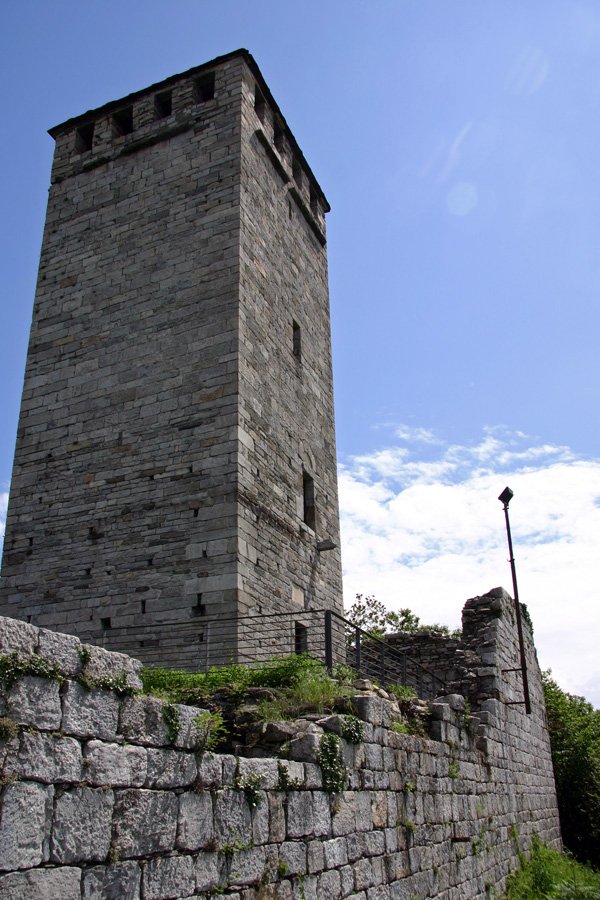

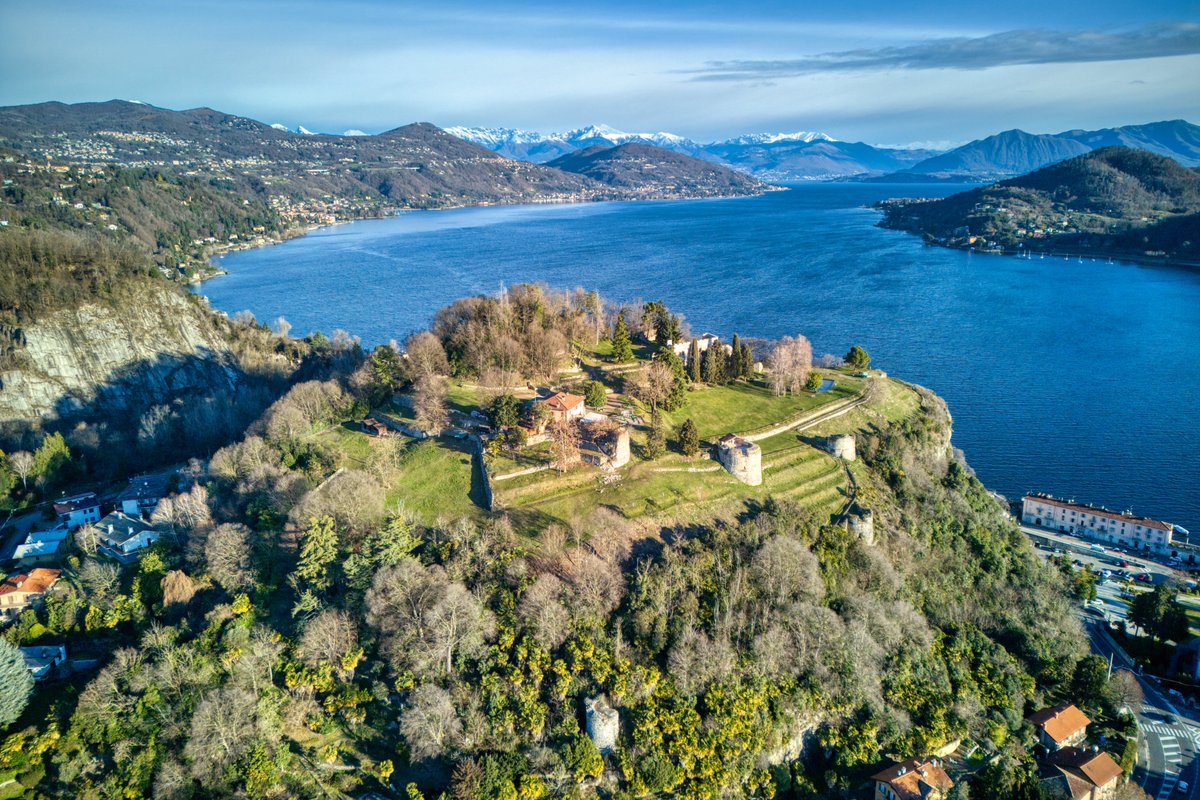
The Torre di Buccione, also known as Castello di Buccione, rises on the summit of a hill at the border between the territories of Orta San Giulio and Gozzano. Located at the southeastern end of the lake, the fortification takes its name from the nearby hamlet of Buccione. Its strong position allows it to dominate the lake and the entire Novara plain, where the church of San Gaudenzio is visible.
Originally a true castrum cited in documents since the 1200s, the structure features a central mastio tower with a square plan. The tower stands 23.20 meters tall and is constructed of squared blocks of various sizes, internally divided into five floors with wooden floors and a covered crenelated cell. The fortification was completed by a square-plan curtain wall and a rectangular service building. A second set of walls, now disappeared, was built in an unspecified era. Access to the fortification is via a plateau described as a walled square capable of holding five hundred men.
While some early 20th-century scholars suggested Roman or Lombard origins, excavations in 2005 revealed that the foundations are located directly in rock carved to hold blocks identical to those of the entire building, disproving the Roman theory. The tower is believed to have been built by the Da Castello counts in the third quarter of the 12th century. It features a bell that was added later, possibly after the roof was completed in the 14th-15th century. Although broken, the bell rang again in 1918 to mark the end of the first world war, and was returned to the tower in 2005 following restoration work.
Sources: Wikipedia, OpenStreetMap, Wikidata, Wikimedia Commons


Written by Nicolo Ciampini
Discuss this with the author and others
No comments yet. Be the first to start the conversation.