Aberdareva 1, Belgrade 11000, Serbia

Baron Wrangel died in Brussels on April 25, 1928, mysteriously and suddenly, after a sudden infection with tuberculosis bacillus. The baron's relatives remained convinced that Wrangel was poisoned. Presumably — the servant's brother, who, as it turned out, worked for the NKVD. The "Black Baron," as he was called for his strict black uniform, is buried in the center of Belgrade. More precisely — reburied a year after his death, in 1929.
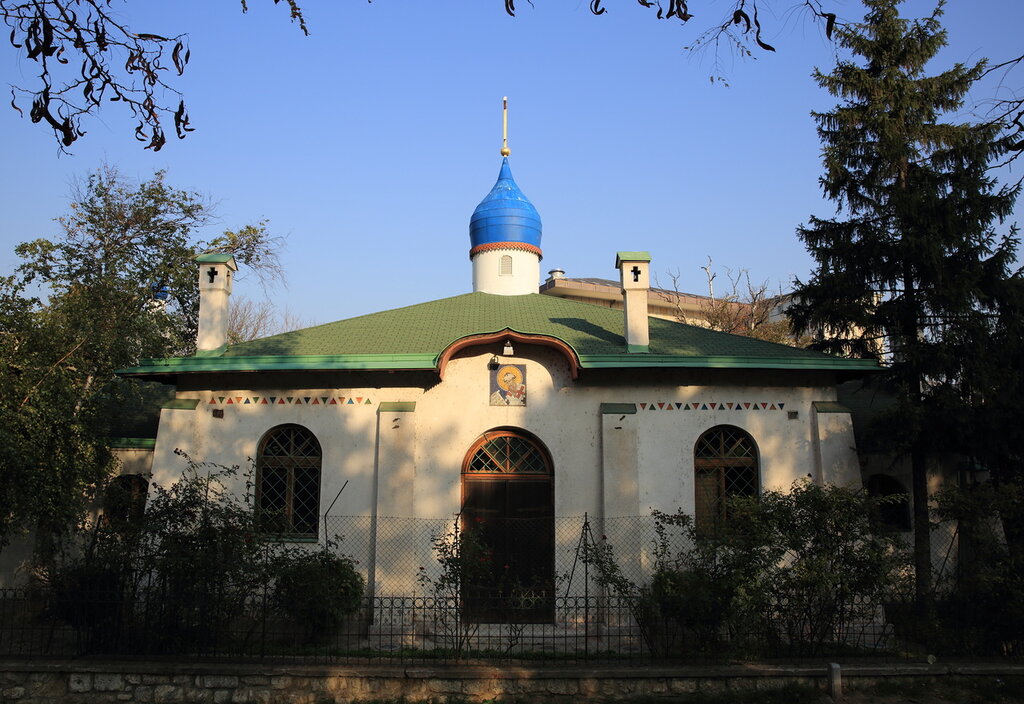
The Russian Church of the Holy Trinity (Црква «Свете Тројице», Russian Church) was built in 1924 with money from the first wave of emigrants. Officers, soldiers, civilians, who flooded out of Russia when the White Guard's struggle against Bolshevism was lost. A handful of land brought from their homeland was laid as the foundation of the church. The small light temple hides behind the Serbian Church of Saint Mark, in Tašmajdan Park, in the center of Belgrade. Until 1924, here, on the territory of the Serbian church, there was a tent of a field Russian military church where services were held. The Trinity Church resembles a neat village church — both inside and out. The iconostasis includes 48 icons painted by Russian émigré artists in the old Novgorod style. In the church, a kiot (icon case) created in memory of Admiral Kolchak is noticeable. This is the icon of St. Alexander Nevsky. Before World War II, the church preserved many royal relics: banners and standards of regiments of the Russian Imperial Army; trophies — battle banners of Napoleon and the Ottoman Empire. In 1944, as Soviet troops approached the Balkans, Metropolitan Anastasy and the core of the White émigré community left Serbia, taking the relics further west and to the USA.
Until the 1940s, the Church of the Holy Trinity in Belgrade was the center of life for the Russian Orthodox Church Abroad. It had no and could not have any contacts with the church in the USSR. Then the first rector, Don Cossack Pyotr Belovidov, died (1940), the ROCOR administration emigrated (1944), and the parish was headed by Father Vladislav Neklyudov. His role was tragic. Under him, the church broke away from the Abroad, becoming part of the Moscow Patriarchate. And in 1949, Neklyudov died in a solitary cell of an investigative prison.
Baron Wrangel was assigned the right part of the church, near the entrance. His grave is embedded in the floor practically under the crucified Christ. In 2007, the baron's relatives (93-year-old granddaughter Natalia Wrangel-Bazilevskaya and her son Pyotr Bazilevsky) received an official offer from Russia — to return Wrangel's remains to Russia and reinter them in the Donskoy Monastery in Moscow. To which lawyer Bazilevsky replied with a polite but firm refusal. "The main character trait of General Wrangel was his principled nature. He fought Bolshevism and the vicious system it spawned not out of class hatred, but from a deep conviction that Bolshevism is absolute evil both for Russia and for humanity as a whole. Over the past two decades, there have been huge changes in the consciousness of Russians... However, the main thing has not happened: condemnation of this evil at the state level... General Wrangel rests in Belgrade, and nearby, in the cemetery, lie thousands of his comrades-in-arms, officers of his army, endlessly devoted to him, to whom he gave his last strength. This mutual trust between the commander-in-chief and his subordinates has no limits — it is not limited by his death or the passage of years. Both in life and in death, he remains in formation together with his officers, soldiers, and Cossacks... Were he alive, he would hardly agree to abandon his army to honorably go to Moscow alone, knowing that Lenin and Stalin still occupy a place of honor near the Kremlin."
Sources:
http://asiagood.ru/mogila-vrangelya-v-belgrade.html
https://ru.wikipedia.org/wiki/Врангель,_Пётр_Николаевич

