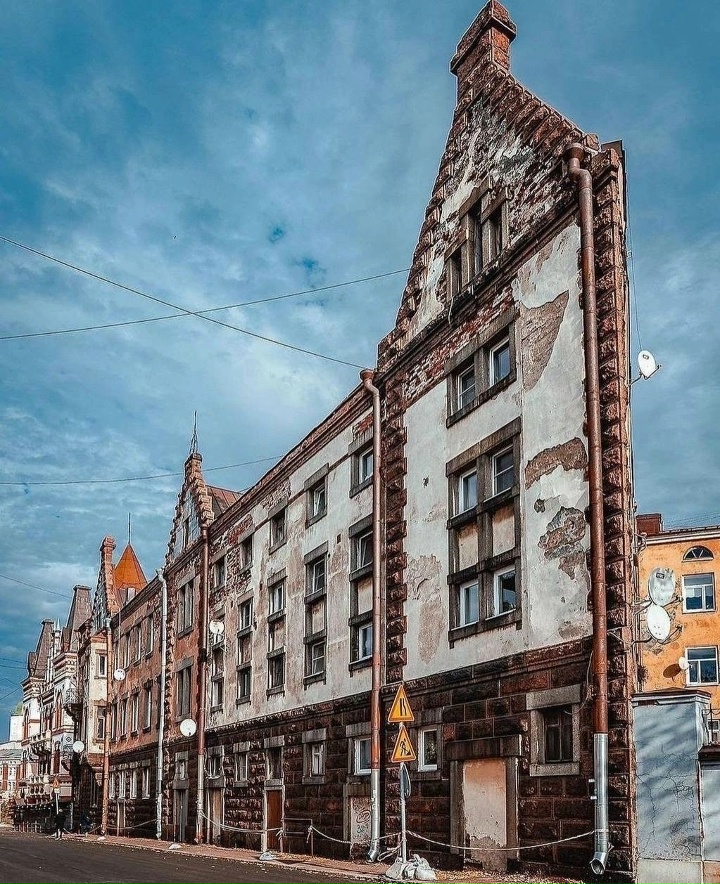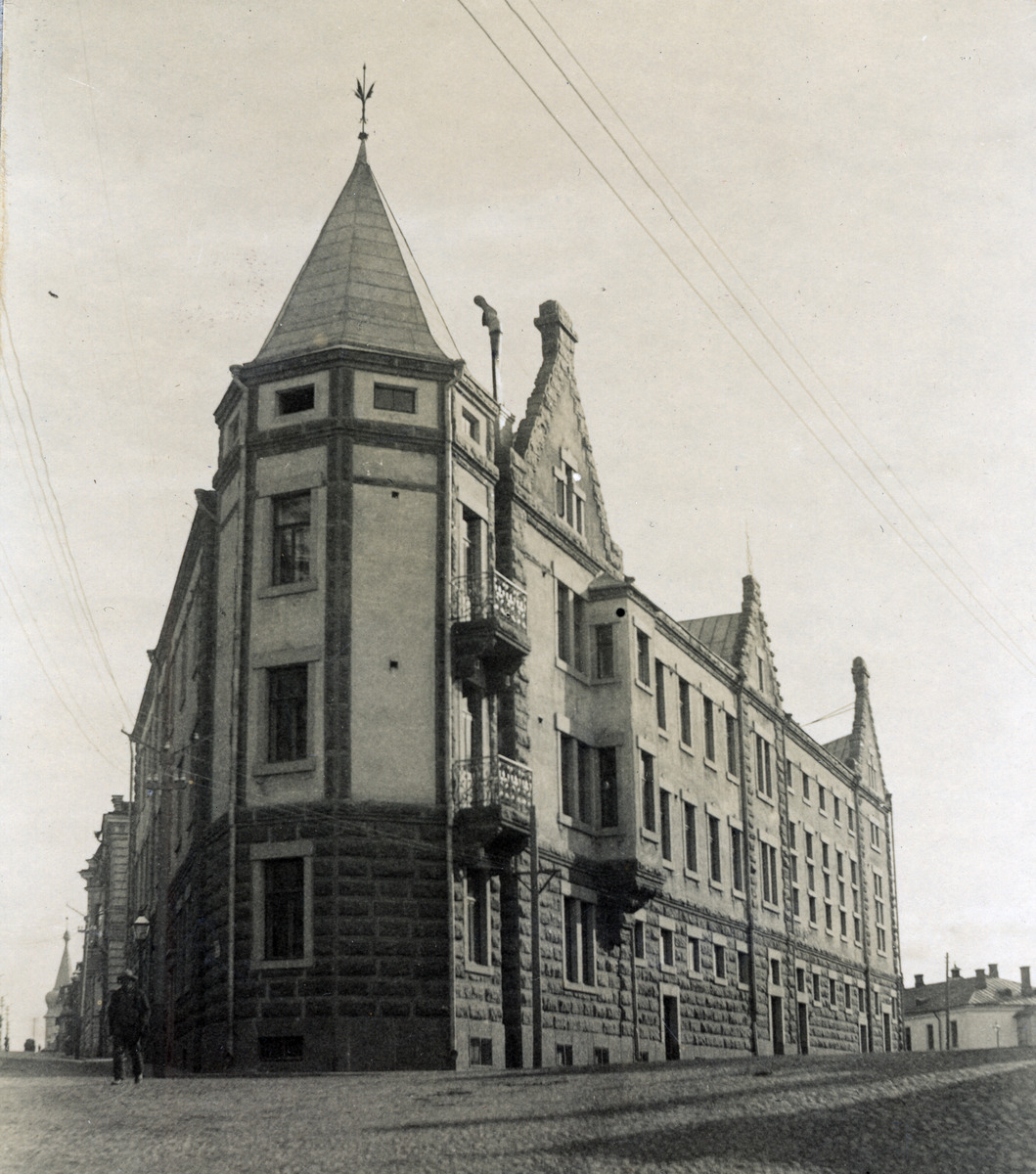
The residential building decorated with rough-hewn granite, resembling a fortress wall with towers, recalls the former city wall that once stood here, the line of which is repeated by Yuzhny Val Street. The income house of the joint-stock company "Torkel," built on the site of a demolished merchant's residential house with commercial and utility buildings owned by Emelyan Koshelev, consists of two blocks of the same height but different numbers of floors: the main block is three stories, while block "A" has an additional floor achieved by lowering the ceiling heights. The building's facade, resting on a massive rusticated granite plinth, is decorated with a series of neo-Gothic elements. Attention is drawn to the sharp corner designed as a tower with a pointed roof, a rectangular bay window at the level of the second and third floors, balconies with intricate railings, and three triangular pediments framed with rustication above the main facade's roof. At the same time, the walls facing the courtyard are devoid of decoration. The first floor housed shops, catering establishments, and offices with separate entrances, while the upper floors were intended for residential use. Although the building dates from a period dominated by historical architectural styles, some researchers associate the appearance of this building with the beginning of the Vyborg Modernism period. During the interior reconstruction carried out in 1938 according to architect V. Rautiainen's project, the utility and commercial spaces were expanded.
During the Soviet-Finnish wars (1939–1944), the building sustained damage. In 1943, a bomb shelter was equipped in the wing facing Vyborgskaya Street. The building was repaired in 1952. In the post-war period, some rooms were occupied by units of the Vyborg Customs, which had previously been located in the neighboring building. During the repairs, entrances to the first-floor premises, which were converted into apartments, were sealed off, and the high, complex-shaped roof was replaced with a flat roof, altering the perception of the triangular pediments, which began to look unstable. As a result of the silhouette simplification, from certain angles on Yuzhny Val Street, the "iron house" with its beveled corner began to appear flat, consisting of a single wall, earning the nickname "the witch's house." There are several legends about why the building is called this. It is said that the name arose from rumors among the residents, especially men, that a real witch lived in one of the apartments, and perhaps all the witches and little witches of Vyborg really gathered for their sabbath in this house.
Similar nicknames ("house of cards," "house without a wall," "flat house") are also connected to the unsatisfactory condition the building fell into after losing its high roof with attic spaces. The peculiarity of this object is that from a certain angle, one wall of the building "disappears," making the house seem flat.
Or perhaps it is because this house has a very unusual configuration.
The last major renovation with a redesign was carried out in the 1970s: stoves and fireplaces were dismantled in the apartments, and bathrooms were installed.
Sources: