Roman Temple, 10980 Alcántara, Cáceres, Spain

The Alcántara Bridge (Puente Trajan at Alcantara) is a Roman stone arch bridge over the Tagus River in Alcántara, Spain. Its architect was Gaius Julius Lacer, and it was built between 104 and 106 AD by order of the Roman Emperor Trajan, who reigned from 98 AD. It was constructed on the road connecting Norba (Cáceres) with Conimbriga (now the Portuguese city of Condeixa-a-Velha). The bridge is 194 meters long, 8 meters wide, and 71 meters high. It has five piers, two abutments, and six arches between them (some of which span 30 meters).


In the center of the roadway stands a Triumphal Arch. It bears two marble plaques.
One plaque shows the construction date and dedication to Emperor Trajan, inscribed: “To Caesar Emperor, son of the divine Nerva, Nerva Trajan Germanicus Datius, Maximus Pontifex, holding tribunician power for the 8th time, imperator for the 5th time, Father of the Fatherland,” and the other reads “Pontem perpetui mansurum in saecula” (I built a bridge that will last forever). Over time, the Alcántara Bridge suffered more from wars than from weather conditions. In 1214, the smallest arch on the left was destroyed by the Moors.
The name “Alcántara,” derived from the Arabic “Al-Qantara,” meaning “the bridge,” reflects the fame this bridge enjoyed during the Middle Ages. One of the spans destroyed by the Moors was rebuilt in 1543 using material from quarries that supplied the original stone.
In 1760, the second arch on the northwest side was destroyed by the Spanish to stop the advance of an enemy army from Portugal into Extremadura and was repaired in 1762 by Charles III. In 1809, during the Peninsular Wars, to prevent Napoleon’s troops from crossing Alcántara, the allies destroyed the second arch on the right bank side. In 1818, a wooden span was built in its place. In 1836, it was burned by the Cristinos to prevent the Carlists from crossing. The bridge was restored in 1860 by order of Isabella II.
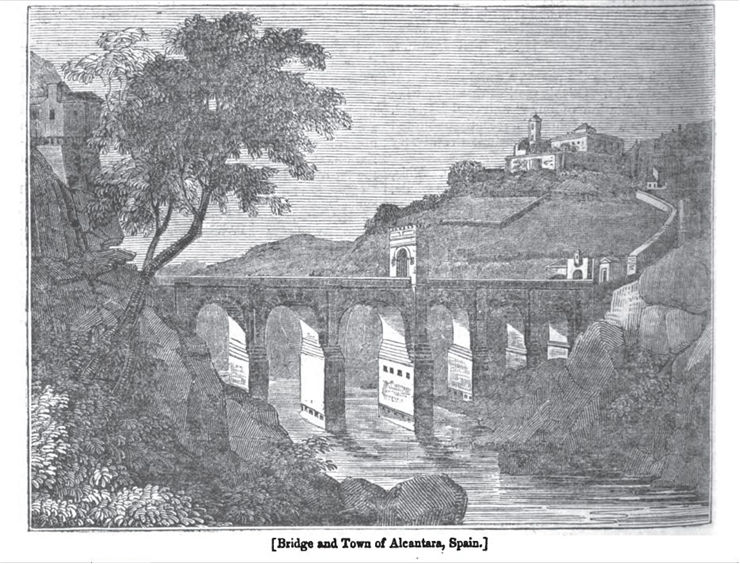
The bridge is a six-span stone arch structure. The span lengths are 13.8 + 22.6 + 27.9 + 28.2 + 22.5 + 13.5 meters. The total length of the bridge is 194 meters, with a width of 8.6 meters. The roadway is 45 meters above the water. The arch spans decrease toward the ends of the bridge due to the terrain of the banks. The springings of adjacent arches on the same pier are thus located at different levels, and all piers except the central one are asymmetrical. This asymmetry is less noticeable thanks to the introduction of buttresses on the bridge’s abutments, emphasizing the vertical element in the overall composition.

According to Professor Nikolaev’s research, the decrease in the spans of this bridge occurs as if the bridge represents a frontal projection of an equal-span arcade curved in plan along a circular arc. The composition of the entire bridge is based on the law of harmonious span reduction according to the division of a semicircle, constructed on a diameter equal to the length of the bridge (centered on the axis of the central pier), into eight equal arcs of 22.5° each. Projecting these divisions onto the diameter (the length of the bridge’s roadway) yields the axes of nine piers, corresponding in orthogonal projection to the axes of piers in a circular-plan arcade with equal spans.
The material for the bridge was gray granite, laid dry with roughly hewn blocks about 2 feet high, with clear and precise joint bonding. The arches on the facade are built from two rings. The outer ring, formed by the projection of header stones, protrudes as an archivolt outlined by a circular arc. A smooth, massive parapet crowns the bridge above a cornice molding with a goose-neck profile, corresponding to the level of the roadway.

The architecture of the bridge clearly shows Roman traditions of the late Republican era, when the central pier was highlighted as the compositional center and the composition harmoniously unfolded on both sides from it. The symmetry of the composition is emphasized by the increasing size of the arch spans toward the middle, as well as by the placement of a triumphal arch above the central pier. Judging by its architecture, the triumphal arch is Roman. It ends with battlements, likely of medieval origin.
On the left bank, next to the bridge’s outermost abutment, a small Roman temple was built. Above its entrance is an inscription dedicated to Trajan, confirming that the builder of the bridge was Gaius Julius Lacer. Nearby, a fragment of a marble slab with a poetic dedicatory inscription was also found:
…A bridge that will endure forever
of lasting peace,
Lacer raised over the river, glorious
with his skill…
The bridge is still in use.
Sources:

