In the 1930s, according to the state plan for the development of natural resources in the Far East regions, the construction of several new industrial centers and railway lines was undertaken. In 1936, the construction of the first railway line Volochaevka-2 — Komsomolsk-on-Amur was completed, and in 1937 the laying of the Komsomolsk — Sovetskaya Gavan line began, which was to include a bridge crossing over the Amur River.
The first surveys for the BAM bridge crossing over the Amur River were conducted in the second half of 1932 by a team from the Lengiprotransmost Institute, which outlined three possible bridge locations within the city: one upstream, another downstream, and a third within Komsomolsk city limits.
In 1936, a resolution by the bureau of the Dalkraykom of the VKP(b) addressed the development of the railway hub in Komsomolsk. The following were to be constructed:
A railway town for 250,000 people (project author Rakov),
A railway branch from Komsomolsk-on-Amur station to the Amur River pier,
A bridge over the Amur (project author Tsybaev),
A tunnel on the right bank of the Amur (technical project by the Lengiprotransmost Institute).
In 1939, in the Komsomolsk-on-Amur area, the Tumnin expedition led by Tatartintsev conducted final surveys for the construction of a bridge over the Amur River. The first two options were discarded because they involved building a long viaduct over the left-bank floodplain. The third option, although requiring a long bridge (2.5 kilometers) and a tunnel on the right bank (800 meters), was recognized as the most economical and technically simple. In 1940, tunnel excavation began. However, the Great Patriotic War altered plans: the bridge was never started, and in 1942 tunnel construction was halted.
The tunnel crossing surveys through Pivanskaya Sopka were carried out by a comprehensive team led by engineer Kuznetsov. Chief geologist Kisel. Project author Vainshtein. According to the report of the Lower Amur ITL, a tunnel works office was established for tunnel construction, courses were opened to train tunnel specialists for the Baikal-Amur Mainline, and a special tunnel laboratory was created.
All crews were staffed with highly qualified specialists — prisoners: locksmiths, machinists, electric welders. The courses trained tunnel foremen, foremen’s assistants, and surveyors. Those engaged in tunnel construction were entitled to enhanced rations, full sets of bedding, and double sets of uniforms.
From February 1940, 250 people from the bridge separate camp point (OLP) of the Lower Amur camp worked on the bridge crossing construction.
The construction included a quarry behind Pivanskaya Sopka, which prisoners called "Pionersky." Next to the quarry was a stone crusher under which wagons rolled on rails. They positioned themselves under a bunker for loading crushed stone rubble. The rubble was transported into the tunnel and used to cover the "floor," on which the railway track was to be laid later.
On October 26, 1940, an 800-meter-long adit was driven through.
At the end of 1940, construction was suspended.
At the beginning of 1941, tunnel construction, as well as the railway bridge over the Amur, began to be wound down because the rails were needed by the Bureinsky camp for the construction of the Izvestkovy — Urgal railway line. Human and transport resources were redirected to the Komsomolsk-Urgal line.
In 1942, an order was issued "On the completion of work on the conservation of the tunnel."
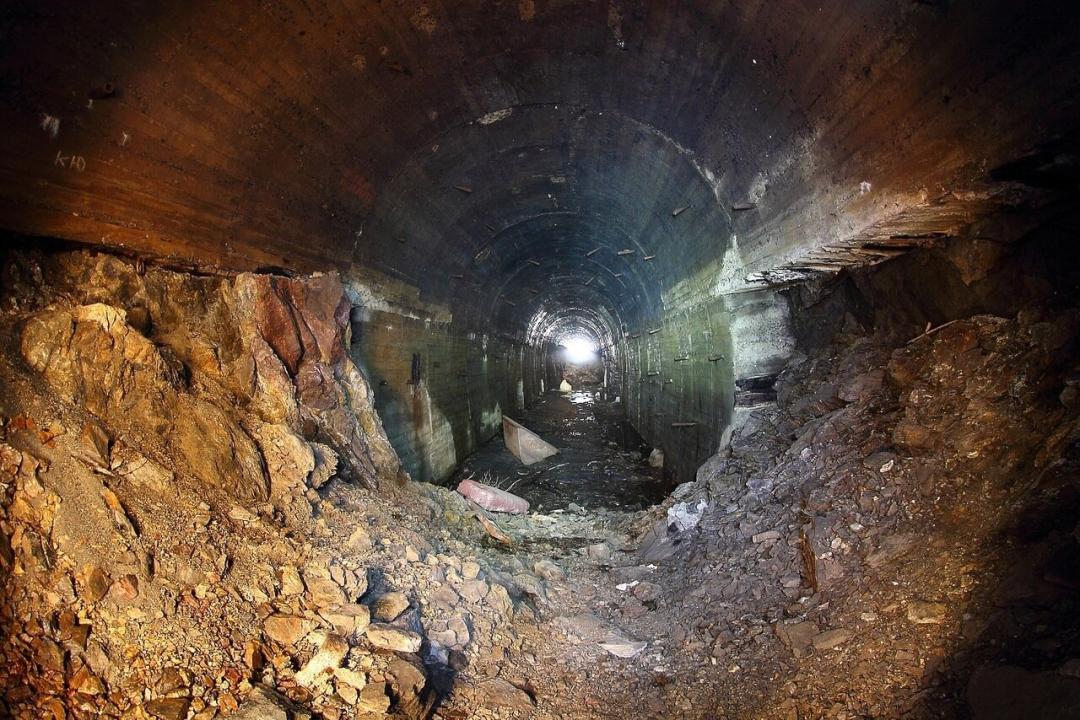
The tunnel was constructed from both sides. Excavation was carried out by drilling and blasting. From the eastern portal side, the face was developed to the full tunnel cross-section. From the western portal side, excavation was done in two benches.
The tunnel profile is single-pitched, rising from the eastern to the western portal with slopes ranging from 0.5 to 1.7%. The lining shape is a steep arch. There is no lighting in the tunnel; ventilation is natural.
1943 was a turning point in the Great Patriotic War. At the same time, Japan, an ally of Nazi Germany, was preparing to invade the Soviet Far East. It was then that the State Defense Committee decided: "Build a railway from Komsomolsk-on-Amur to Sovetskaya Gavan." The deadline for opening operational traffic, primarily from Komsomolsk to Vanino Bay, was set for August 1, 1945. It was proposed to revise the previously developed construction project, originally planned for 4 years, simplifying it to a 2-year construction period.
Instead of a 2.5-kilometer bridge over the Amur River, build a ferry crossing with two ferries.
When crossing the Sikhote-Alin mountain range, instead of two tunnels, build a road bypassing the mountain massif using triple locomotive traction (laying more than 500 km of railway tracks).
The road construction was assigned to the People's Commissariat of Internal Affairs represented by the then head of the Railway Project of the GULZHD NKVD, F. A. Gvozdevsky. The project was designated "Construction No. 500." All expedition leaders, comprehensive teams, and construction trusts were given the construction chief's order, Major General Gvozdevsky: "Do not build bridges or tunnels!"
In 1965, the question arose about resuming the construction of the bridge crossing over the Amur. It was necessary to consider new options taking into account the increased clearance height, increased suspended load, and, most importantly, designing supports for combined automobile and railway traffic. First, it was decided to assess the suitability of the 1939 option, approved based on the 1932 survey materials.
Increasing the height was impossible due to the low location of the Pivan station. If a new station were built on the right bank at higher elevations, the height of the approach embankment within the city would also need to be increased. Moreover, this would mean abandoning the already started construction of the Pivan tunnel.
Reasons for rejecting the construction of a drawbridge span:
- It is cumbersome.
- It would create certain obstacles to navigation on the Amur.
It is difficult to determine the location of this span: the river's hydrological conditions are unfavorable; the Amur's channel at the bridge crossing site has an excessive live cross-section, causing constant reshaping with significant lateral shifts of the fairway and changes in depth. Additionally, the island located upstream of the proposed bridge was moving downstream and growing upward, which could adversely affect the redistribution of water flow across the river section and cause dangerous scouring. Besides this, the narrowed part of the river below the bridge and several small islands predetermined the formation of large ice jams and scours in this area, affecting the stability of the supports.
The conditions for entering the bridge forced designers to place the automobile part of the crossing on the upstream side of the supports. In this case, during the initial period of bridge operation, when only railway loads would act on it, the lower part of the supports, without automobile span structures, would be in very unfavorable conditions. To ensure sufficient loading, it was necessary to increase the foundation sizes of the supports. Additionally, to exit the automobile road from the bridge, a new large-section and long tunnel had to be built.
All these conditions determined the fate of the Pivan tunnel. After long surveys, it was decided to build the bridge crossing over the Amur in another location.
The Pivan tunnel is completely abandoned. Construction and design documentation for the structure have not been preserved. There is no acceptance certificate for the tunnel. The tunnel has the following characteristics:
non-standard dimensions (caused by over-excavation and under-excavation of soil during drilling and blasting);
- defects in the roadway combined with significant moisture (due to leaks through technological joints in the monolithic reinforced concrete and shotcrete lining — there is no waterproofing behind the tunnel lining, as well as due to unorganized drainage);
- complete absence of tunnel lighting;
- lack of protection against rockfall at the approaches to the Western and Eastern portals;
- absence of deformation and seismic joints in the tunnel;
In the 2000s, local entrepreneurs wanted to set up mushroom-growing workshops in the tunnel adit. The tunnel has become a pilgrimage site for urban explorers (diggers).
The eastern portal is located on the territory of the "Pivan" gardening association. The road leading to the tunnel within the "Pivan" gardening area is called Tunnel Street. Thanks to lease agreements between the "Pivan" gardening association and the Pivan village administration, the eastern portal of the tunnel (excavation bottom and slopes) began turning into an unmanaged dump. Therefore, in December 2011, an initiative group "Tunnel" was formed at the Komsomolsk-on-Amur branch of the Russian Memorial Society, aiming to restore the historical complex on the right bank of the Amur near Pivan. In 2012, through the joint efforts of enthusiasts, gradual clearing of the tunnel excavation began, the garbage on the slopes was covered with sand by the district administration, and the area around the eastern portal was fenced with barbed wire.
The tunnel was forgotten; a gardening community formed around it, the tunnel entrance turned into a dump, and only the street name "Tunnel Street" in the gardens reminds of the past.
In early 2012, on the hill directly above the tunnel entrance from the Amur side, a memorial sign to the victims of political repression was installed (author and executor — Komsomolsk resident Viktor Zagryanin).
Sources:
https://cvarnou.livejournal.com/43455.html
https://ru.wikipedia.org/wiki/Пиванский_тоннель
http://kfss.ru/content/pivanskiy-tonnel