Malaya Sadovaya St., 2, Saint Petersburg, Russia, 191023
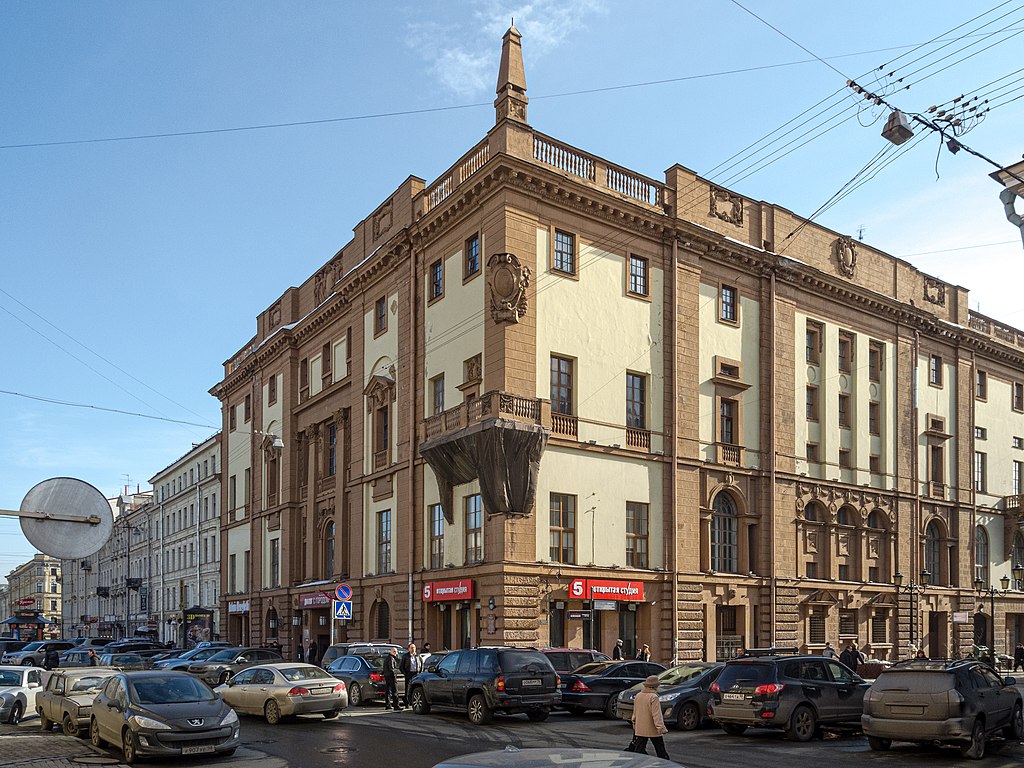
The building on the corner of Malaya Sadovaya and Italian Streets was constructed between 1912 and 1914 in the neoclassical style for the Saint Petersburg Noble Assembly, designed by the architect brothers Kosyakov — Vasily Antonovich, Vladimir Antonovich, and Georgy Antonovich.
For nearly the first 100 years of its existence, the house belonged to two merchant families: first to the merchant Sutugin and his descendants, and then it was acquired by the merchant Yakov Gavrilovich Vasiliev. In 1911, the son of merchant Vasiliev sold the house along with all the buildings and the plot to the Saint Petersburg Noble Assembly.
The Noble Assembly traces its history back to the Merchant Assembly, established in 1782 by a group of individuals who left the Bürger Club. The name changed many times thereafter. Any member of society could join the assembly, "except military personnel above the rank of colonel; this exclusion did not apply to civilian ranks." In its early years, the club was nicknamed the "American" among St. Petersburg residents, probably because it admitted all social classes or because its founding year coincided with the year the United States of America declared independence. People came there to spend their free time: playing cards, billiards, dancing, and organizing lunches or dinners. I. GODA Georgy described this establishment in his 1794 works as follows: "This [club] is now located in the Poggenpole house near St. Isaac's Church and had 500 members in 1793." By 1792, the number of members reached 550. The society's income was formed from annual membership fees (16 rubles), and revenues from masquerades and balls (entrance fee — 5 rubles). The assembly was housed in various buildings across the city and often relocated. From 1822, the assembly was located in the Tairov house on Millionnaya Street. Its membership dropped to 314 in 1822 and to 165 in 1824. From 1824, the assembly changed its location every season. Since 1845, it was officially called the Noble Assembly.
Gradually, financial affairs improved. In the 1870s-80s, literary evenings were held in the Noble Assembly premises with the participation of I. S. Turgenev, M. E. Saltykov-Shchedrin, and F. M. Dostoevsky.
The architectural and artistic design of the Saint Petersburg Noble Assembly building contains features, forms, and motifs of several styles simultaneously: Art Nouveau and Classicism. At the core of the facade composition, the architect managed to combine two opposing principles: symmetry and asymmetry.
Together with the facade drawings and floor plans, cross-sections of the Noble Assembly building were discovered, documenting the building's structural system. In the main cross-section, most rooms on all floors had vaulted ceilings. The largest room was the theater hall on the second floor with a mirror vault. Additionally, this cross-section captured window openings in the northeast part of the building facing a small courtyard. On each floor level, small square windows formed a row of three.

The longitudinal section allows us to examine the layout of several more halls on the second floor: the vestibule and the anteroom. The vestibule was covered with a mirror vault. On the staircase side, a three-span arcade was formed, supported by two pylons.

During World War I (1914-1918), the building housed a hospital of the Japanese Red Cross. It opened on December 6, 1914, with a medical staff consisting of four doctors, seven nurses, two pharmacists, a manager, and an Orthodox priest Father Pavel (Akira Morita), who was the rector of the Epiphany Church in Tokyo. Most of this team had combat experience, having participated in the Russo-Japanese War (1904-1905).
During this time, the Japanese medical staff learned Russian, knowledge that later proved useful in Saint Petersburg. They equipped their hospital with advanced equipment and brought all necessary medicines with them.
Initially, the Japanese hospital occupied rooms on the fourth floor, but soon the number of beds had to be increased. Thus, the hospital took over the entire building except for the theater hall and its adjoining rooms (which remained under the Noble Assembly's control). In December 1915, a temporary Orthodox Church of Saint Nicholas the Wonderworker was established in the small theater dining room on the second floor, where Father Pavel served.
Alongside the Japanese staff, Russian doctors also worked in the hospital. This cooperation lasted until April 1916, when the Japanese team left Saint Petersburg. Until the end of 1917, only the Russian hospital remained in the building. By this time, the Noble Assembly had ceased to exist.
From 1918 to 1933, the building housed the Palace of Proletarian Culture. This institution occupied only part of the premises. The rest were given to other organizations. For example, in 1923-1924, the "Proletkult" publishing house was located here; then until 1940, the "Koloss" cinema was housed in the building, occupying the former concert hall, anteroom, and foyer on the second floor. Alongside the palace and cinema, several premises were occupied by: the production cooperative "Bolto-Glukhary," the mass cultural-educational and literary-artistic organization of proletarian amateur activity under the People's Commissariat of Education "Leningrad Proletkult," the Leningrad branch of the foreign workers' publishing house in the USSR "Vegaar," and the "Mezhrabpom" cinema.
In 1933, the Palace of Proletarian Culture vacated the premises. Instead, the Committee for Radiofication and Broadcasting was established here, colloquially known as the House of Radio. From this time, a new chapter began in the history of the former Noble Assembly building. This institution occupied the Kosyakov brothers' building until the 2020s. The name "House of Radio" firmly stuck to this building.
A significant remodeling in the 1930s was necessary for the proper functioning of the House of Radio: special studios and a radio apparatus room capable of simultaneously broadcasting 10 radio programs were installed here. During the Great Patriotic War, "broadcasts went to the city from here," as Olga Berggolts wrote about the House of Radio.

Loudspeakers, so-called black "plates," appeared on the streets. The blockade broadcasting was not interrupted for a single day. The radio was a voice of salvation for the people of Leningrad. "Nowhere did radio mean so much as in our city during the days of war," wrote Olga Berggolts. The building was repeatedly shelled. A special team was on duty on the roof of the House of Radio to extinguish incendiary bombs. During one air raid, a bomb pierced the entire building down to the first floor but did not explode. The bomb's impact caused the destruction of one of the studios located on the fourth floor.
The question of restoring the House of Radio arose as early as 1943. The Executive Committee of the Leningrad Regional Council of Deputies and Workers considered estimates for repairing the iron roof, repairing and installing stoves, restoring the room on the fourth floor damaged by artillery shelling, repairing the water supply system, repairing window frames and doors, and waterproofing the basements of the House of Radio.
After the war, only the House of Radio remained in the building. Therefore, a large-scale reconstruction of the building was necessary to adapt it into a modern broadcasting center. This required changing the building's layout: new studios and the technical rooms necessary for their operation were planned. The foyer and anteroom on the second floor were to be preserved. The former cinema hall was to have its finishing changed to meet the required acoustic characteristics. The reconstruction project for adapting the building into the House of Radio was prepared in 1947 by LENNIIPROEKT.
Some rooms of the House of Radio appeared after the building's restoration from 1950 to 1954. On the second floor, the main concert hall with 300 seats and a large concert studio were arranged. The main concert studio was located in the theater hall. Its acoustic treatment was made of perforated plywood structures filled with loose asbestos fiber cord. The ceiling was treated similarly on 75% of its surface. The large concert studio was formed after remodeling the former theater dining room of the Saint Petersburg Noble Assembly building. Semi-cylindrical plywood surfaces were located in the wall piers. The ceiling was suspended and coffered.
Most of the new studios appeared on the third floor. Here were located a single-chamber and four speech studios, as well as studios of the literary drama block. All rooms had the same acoustic wall treatment: perforated plywood structures. The ceilings in all studios were perforated. The only exception was the main studio of the literary drama block: its interior was complemented by columns and pilasters, and the ceiling was deeply coffered.
The lion's share of the remodeling was concentrated in the rooms on the 3rd and 4th floors and their corresponding mezzanines.
In March 2024, the House of Radio closed for restoration, which will last until 2026.
Sources:
https://ru.wikipedia.org/wiki/Дом_Радио_(Санкт-Петербург)
https://www.ibgroup.ru/news/2024/01/25/740/

