Skolas Street 3A, Alsunga, Alsunga Parish, Kuldīga Municipality, LV-3306, Latvia
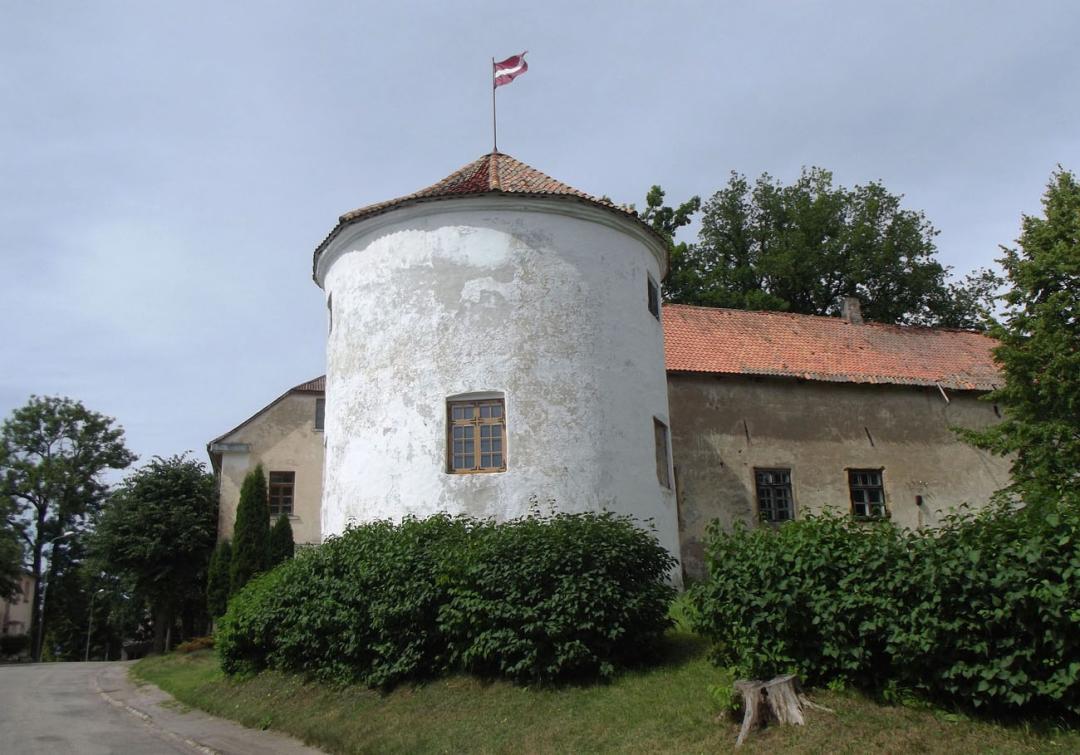

Alsunga Castle (Latvian name Alsunga) was one of several Teutonic fortifications guarding the route through Courland, connecting Livonia with Prussia. The first records of the settlement were documented in 1230, but the castle itself was only mentioned in a document from 1341. It was built somewhat earlier and was administratively subordinate to the commandery in Goldingen, now Kuldīga. It did not serve an administrative function within the Teutonic authority but had economic and strategic significance.
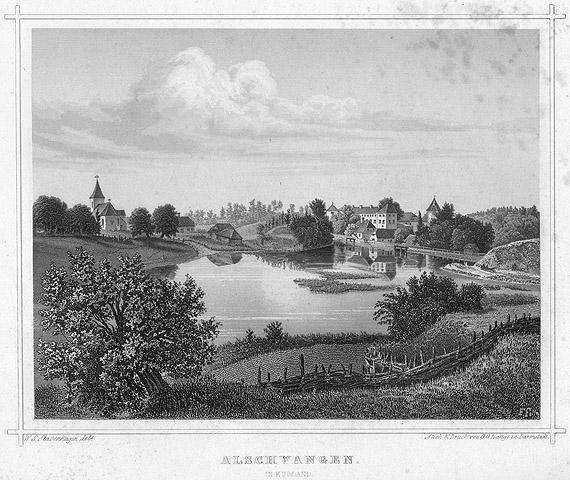
At the end of the 15th and the first half of the 16th century, the castle was slightly expanded and strengthened, adapting it for the use of firearms. However, it did not have great military importance and after the secularization of the Livonian branch of the Teutonic Order, it became private property of the German noble family Schwerin. In the following years, it was repeatedly damaged during the Polish-Swedish wars, after which it was always rebuilt, losing its medieval fortress appearance in favor of a residential residence.
The castle was located on a small hill on the bank of a stream or small river flowing along the northern side of Alsunga and flowing into a lake to the east. It consisted of a stone four-sided defensive wall measuring 60 x 65 meters, surrounding a courtyard which, due to its considerable size, was probably a place of refuge for travelers and the local population. Originally, the building had no towers, so its defense had to rely on long curtain walls, probably topped with a wall-walk and battlement parapet.

Inside the defensive perimeter, the castle had two wings of buildings, in the eastern of which were the main rooms and chapel, while the southern wing served economic functions. In the second half of the 15th century, the southern wing was built up with an additional floor and extended westward, filling the entire width of the courtyard. Access to the rooms on the first floor was provided by a wooden cloister or porch attached to the facades of both wings facing the courtyard.
At the turn of the 15th and 16th centuries, round towers adapted for the use of firearms were added to the northeast and southwest corners of the castle. It was almost entirely designed from the front perimeter, with small fragments touching the eastern and southern wings, with the southwest tower protruding unevenly, more in front of the southern curtain than the western one. The interior of the northeast tower was divided into five floors, the lower three of which were vaulted, and the upper two were separated by a wooden ceiling. The second tower likely had a similar room layout.
The castle has survived to this day, but in a form significantly altered in the early modern period, only the main medieval shape remains, including both characteristic corner towers. The layout of the rooms in the medieval wings has changed, and western and northern wings were added in the 18th century. Currently, there is a small museum exhibition inside the castle.
Sources:
https://www.castle.lv/latvija/alsunga.html Project by Renāta Rimša
https://medievalheritage.eu/en/main-page/heritage/latvia/alsunga-castle-alschwangen/

