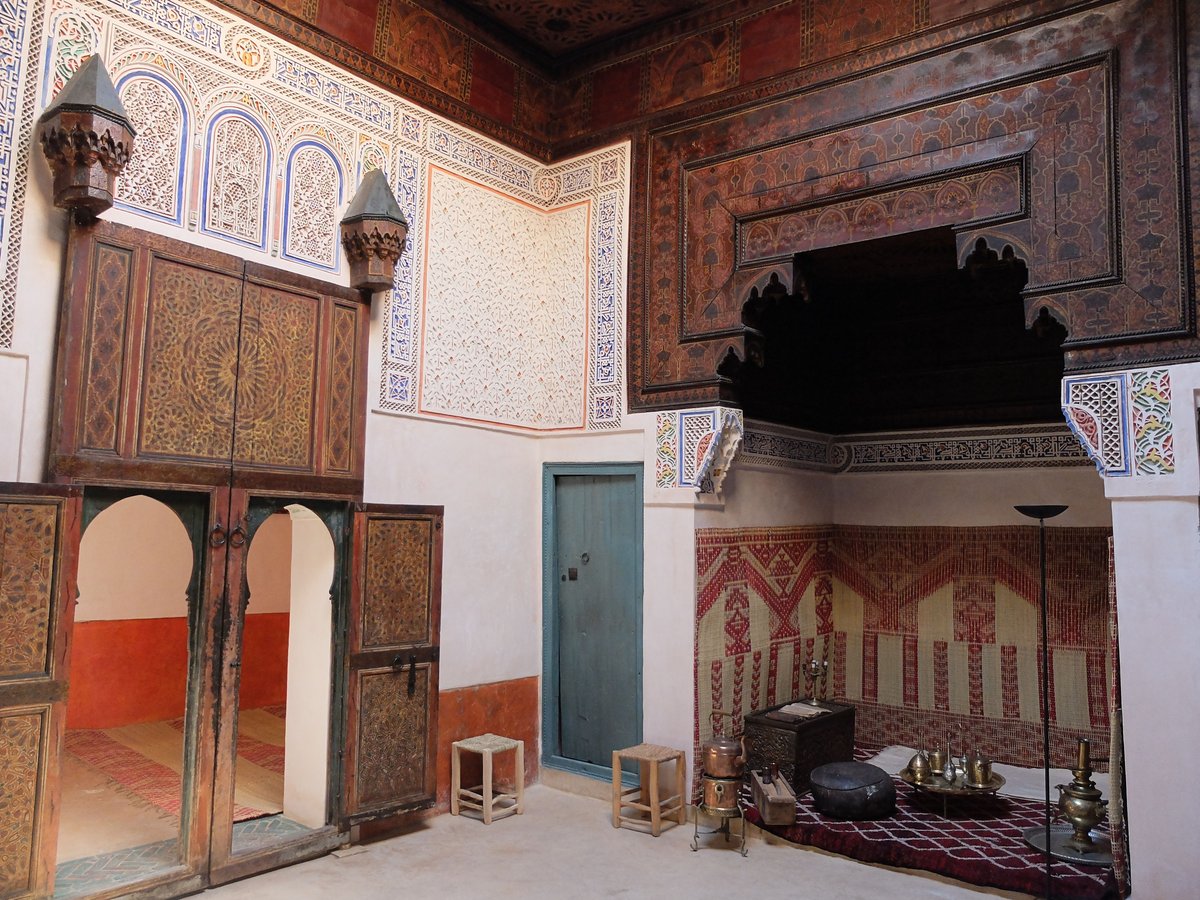

Located in the Mouassine neighborhood of the historic medina of Marrakesh, the Musée de la Musique is housed in a recently restored 16th to 17th-century house. The building was constructed in the 1560s by an aristocratic Sharifian family during the Saadian period, a time of significant development for the district. It sits next to the southeastern corner of the Mouassine Mosque along Derb el Hammam street.
The house features a douiria, an upper-floor apartment used to receive guests, reached via a short staircase. This leads to a square salon with a wooden ceiling and a central skylight, flanked by large alcoves sheltered by wooden canopies. The main room is rich in decoration, featuring carved stucco with geometric patterns and Kufic letter motifs, alongside sculpted and painted wooden ceilings. Some of the painted sun motifs and side room ceilings date from the reign of Sultan Moulay Isma'il in the late 17th or early 18th century.
After being inhabited by the local Mellakh family since 1954, the house was purchased in 2012 and underwent a meticulous restoration. Experts discovered that original pinkish gypsum-based stucco was hidden beneath layers of modern white plaster. Craftsmen painstakingly removed the plaster to reveal the historic decoration and preserved colors. Opened as a museum in 2014, the building became a Museum of Music in 2019, hosting permanent and temporary exhibits alongside regular musical performances.
Sources: Wikipedia, OpenStreetMap, Wikidata, Wikimedia Commons
Written by Mutabor
Discuss this with the author and others
No comments yet. Be the first to start the conversation.