Parkovaya St., 19, Vyborg, Leningrad Region, Russia, 188811

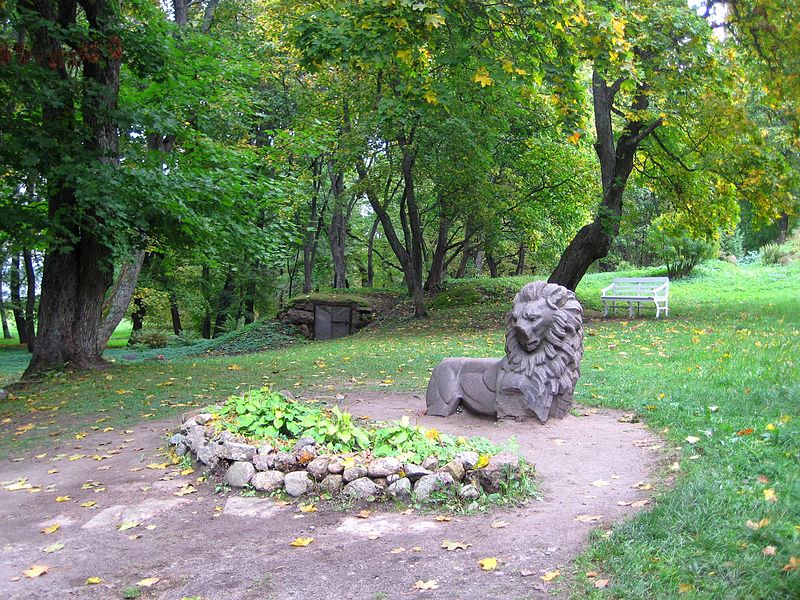
In the Monrepo estate, which has become a museum-reserve, the Vyborg symbol of Finnish independence found refuge — a granite lion created by sculptor Gunnar Finne. Few Finns, among the generations who honor their history, do not know that a Monument of Independence was erected in Vyborg, the design competition for which was held in 1924 among sculptors from all over the country. But few Finnish tourists visiting Monrepo realize that the granite lion on the lawn in front of the museum-reserve’s administration building is the very same one that proudly overlooked the city from the top of Tervaniemi Hill, or Petrovskaya Hill (the old name of Smolyanoy Cape). It is hard to believe, but this is the granite monument of Finnish independence.
A bit of history: in 1910, on the summit of Petrovskaya Hill, a monument to Peter the Great was erected in honor of the 200th anniversary of the city’s capture by Russian troops. This happened at a time when relations between the Russian Empire and its autonomous Grand Duchy of Finland were no longer amicable. After Lenin signed the Decree on Finnish Independence and the failed Finnish revolution, the suppression of which took place amid hostility also toward everything Russian, the monument to Peter I, which reminded of Russia’s greatness, was toppled on July 21, 1918. The idea to place a monument on the rock summit, on the site of the demolished statue of the Russian emperor, was proposed by Vyborg native Major General Teslev, who also donated money for the creation of the sculpture (about one hundred thousand Finnish marks). From 1927 to 1940, the lion stood on the high pedestal of the Peter monument in Petrovsky Park in Vyborg, holding the coat of arms of Vyborg Province in its right paw. In 1940, Soviet troops restored the monument to Peter I to its historic place, and the Finnish lion was thrown off the cliff. Upon falling, the granite sculpture cracked, and the lion lost its paws. However, in 1941, the fragments of the sculpture were reinstalled in the park by Finnish soldiers, who again toppled the monument to Peter I after capturing Vyborg during World War II. Later, the returning Russians once again threw the granite crippled lion down and, to be sure, buried it in Monrepo Park, where it was found in 1989 by museum staff and carefully installed by them among the grass and flowers. It still stands there to this day, quite familiar and homely to the local inhabitants, a descendant of that ancient sword-bearing lion that recently adorned yellow pennies and stamps.
Sources:
https://ru.wikipedia.org/wiki/Monument_of_Independence_(Vyborg)

