In place of the Horse Guards Boulevard, a canal was laid out during the Petrine era. It served to deliver shipbuilding timber to the Admiralty Shipyard from the Galerny Yard, which is why the canal was called the Galerny Canal.
On the bank of this canal, barracks for the Horse Guards Regiment were built as early as the beginning of the 19th century. The Horse Guards Regiment was originally formed based on the life squadron of Alexander Danilovich Menshikov, the house dragoon company of General Field Marshal Sheremetev, and the dragoon company of the Saint Petersburg provincial battalion. This regiment participated in the Russo-Turkish and Russo-Swedish wars, as well as in the Patriotic War of 1812. It was considered one of the most privileged regiments, enjoying special attention from the emperors. Previously, the regiment was stationed in Saint Petersburg in the Smolny Yard area. The regimental settlement moved to the area between Saint Isaac’s and Annunciation Squares in 1805–1807.
Traditionally, the regimental settlement included the barracks buildings, the regimental church (Annunciation Church—no longer preserved), and the officers' quarters. The complex of regimental buildings also included the Manege, built according to the design of architect Quarenghi in 1804–1807.
The Manege was constructed during the Napoleonic Wars, and very quickly, to be ready for the return of the Horse Guards Regiment from Europe. Saint Isaac’s Square was already conceived as an important architectural dominant of Saint Petersburg, so a large budget was allocated for the Manege’s design.
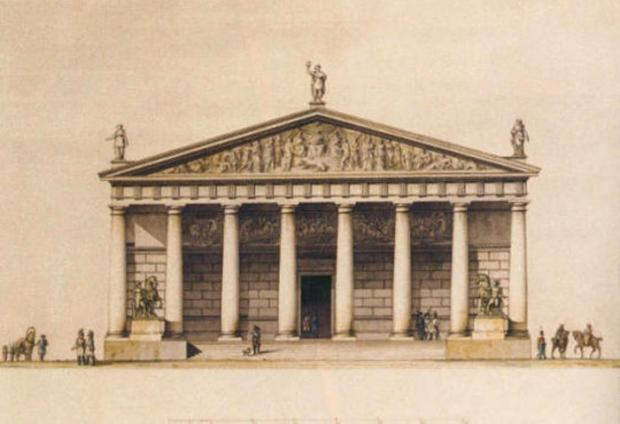
The Manege building is rectangular in plan, elongated lengthwise. Almost its entire volume was once occupied by a large hall intended for horseback riding exercises. The side facades are simply designed, while the facade facing Saint Isaac’s Cathedral has a more solemn design. The majestic portico is crowned with a pediment; in the central part of the portico is a double colonnade. The tympanum of the pediment was formerly decorated with a sculptural bas-relief depicting the ceremonial awarding of prizes to winners of equestrian competitions (sculptor Triscorni, based on Quarenghi’s drawing). Almost the entire interior volume of the building was once occupied by one large hall intended for horseback riding training.

Three decorative statues of ancient heroes were installed on the pediment. The double colonnade in the central part of the portico enhanced the grandeur of the main facade. Between the pilasters of the loggia formed inside the portico, bas-reliefs depicting sports games in an ancient circus were executed.
Gentle ramps were made on the sides of the portal for entry. Sculptural groups of the Dioscuri were installed on pedestals in front of the portico.
The marble sculptures of youths restraining rearing horses were made in Italy by sculptor Triscorni from Carrara marble and brought to Russia in 1817.
The statues were copies of the Dioscuri installed in Rome at the Quirinal Palace. The fate of the Saint Petersburg copies of the mythological twins, sons of Zeus and Leda, who symbolized brotherly love in pagan culture and were therefore always depicted together, mirrored, was dramatic.
In 1840, the chapter of Saint Isaac’s Cathedral considered the presence of statues of naked pagan gods near a Christian temple to be sacrilegious. The marble sculptures were removed from their pedestals. They were installed behind the Manege on the gate pylons of the Horse Guards barracks. There, according to city authorities, they were to be perceived not as gods, but exclusively as youths with horses, which corresponded to the nature of the Horse Guards Regiment. The Dioscuri returned to their historical place only in 1954.
In 1872–1873, the Manege building was rebuilt under the supervision of architect Grimm. An extension was added to the southern side of the Manege building.
In 1873, terracotta bas-reliefs depicting equestrian contests of ancient heroes, created by sculptor Jensen, were installed in the pediments of the frontons. In the 1930s, after a fire, the authorities converted the building into a garage for NKVD troops (the reconstruction was led by Lansere), and the bas-reliefs were removed. During the war, the building was heavily damaged. In 1977, the Manege was converted into an exhibition center. At that time, its facade was thoroughly restored in accordance with Giacomo Quarenghi’s original design.
During the Great Patriotic War, the Manege building was damaged. After the war, restoration work was carried out. In 1973, the Leningrad Executive Committee decided to reconstruct the Manege building and convert it into an exhibition hall. The appearance of the facades was brought as close as possible to the original Quarenghi design. Spacious exhibition halls were created inside.
The central exhibition hall "Manege" opened on November 5, 1977, with an exhibition of works by Leningrad artists titled "Art Belongs to the People."
In 2000, the decorative statues from 1872–1873 were removed from the pediment of the main facade for restoration. The recreated statues were returned to the pediment in 2006. The latest restoration of the facades and the sculptural groups of the Dioscuri took place in 2001–2003.
Sources:
http://www.hellopiter.ru/Arena_konnogvardejsky_regiment.html
https://www.citywalls.ru/house719.html
https://ru.wikipedia.org/wiki/Конногвардейский_манеж


