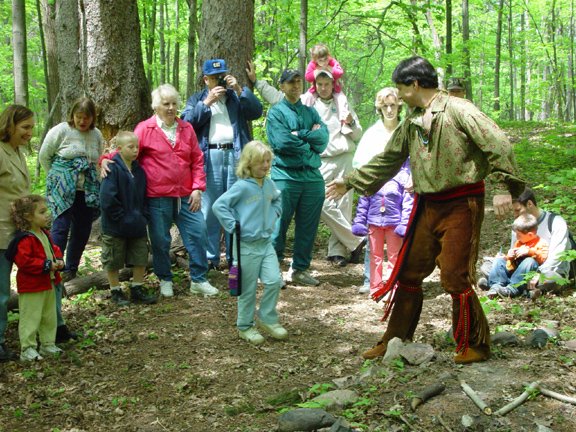
Apple Island is a 35-acre island that lies in the middle of Orchard Lake, in Orchard Lake Village, Michigan. The island was formed during the recession of the region's last ice age glacier 10,000 to 12,000 years ago. It rises to an elevation of 960 feet, approximately 31 feet above the normal elevation of Orchard Lake. Today, it serves as an educational nature center used by the West Bloomfield School District, and it contains examples of every type of ecological system identified within southeastern Michigan, including over 400 species of flora.
The island's history is marked by significant archaeological finds. In the 1930s, a French-made spun pewter bowl filled with wampum was discovered in a nearby cornfield; the bowl, crafted in the late 18th or early 19th century, was probably a gift from the French to the Native Americans and is now in the Cranbrook Collection. Test pits dug in 1997 yielded pottery and stone tools on the west side of the island. While there is no evidence that pottery production occurred on the island, these artifacts signal the influence of early Europeans on the area's native population.
Native Americans inhabited the island until ceding it to the United States in the Treaty of Detroit. Tradition states the island served as a stronghold for Native Americans for several centuries, with meetings reportedly taking place between tribal groups such as Chief Walk-in-the-Water and Chief Pontiac. While the specific words Native Americans used to refer to the island remain a mystery, one writer notes a lake in the area was called Menahsagorning, or "apple place," because of the nearby orchards. Early white settlers consequently named the body of water Orchard Lake and established a town there in 1827.
Following the Treaty of Detroit, James Galloway purchased the island on June 18, 1827, for eleven shillings and eight pence per acre. Galloway's last will and testament in 1838 left the land to his daughter, Julia Ann Galloway. In 1847, Joseph Allen paid taxes on the island. The island was eventually listed on the National Register of Historic Places in 2018 for its archaeological significance, recognizing the many clues left behind by the various groups who frequented the island over the centuries.
Sources: Wikipedia, OpenStreetMap, Wikidata, Wikimedia Commons
Written by No Other
Discuss this with the author and others
No comments yet. Be the first to start the conversation.