Utkin Ave., 2A, Saint Petersburg, Russia, 195027

There is a theory that before the founding of Petersburg, this area near Nienshanz was owned by a certain Swedish colonel Okkerville. However, scholars still debate the connection between his surname and the name of the left tributary of the Okhta River. Some researchers believe that the word "Okkerville" has a Finnish root and question the existence of the colonel. One thing is certain: the estate changed hands many times. At the end of the 17th century, it belonged to the pastor of the church in the Swedish town of Nien. In 1712, its owner was Stepan Petrovich Neledinsky-Meletsky, a stolnik of Peter I; in the 1730s, it belonged to General-anshef, head of the Secret Chancellery, Andrey Ivanovich Ushakov. In the mid-18th century, the estate was owned by Mark Fyodorovich Poltoratsky, director of the Court Singing Chapel, and his wife Agafokleya Alexandrovna. The estate was awarded to Mark Fyodorovich for his participation in opera productions. The founder of this noble family, Mark Fyodorovich Poltoratsky, came from Ukrainian Cossacks. Possessing a magnificent voice, he sang in the church choir from a young age. He studied in Chernihiv, then in Kyiv, where he was heard by Alexey Grigorievich Razumovsky, who had already made a rapid rise from a chorister to the favorite of Empress Elizabeth Petrovna. Thanks to Razumovsky's patronage, Poltoratsky moved to the capital and made a brilliant career. Mark Fyodorovich became the first Russian artist invited to sing with an Italian opera troupe performing in Saint Petersburg. He appeared on stage as Marko Porturatsky. From 1763 to 1795, he was the director of the Imperial Court Singing Chapel.

It was under the Poltoratskys, albeit not immediately, that the estate flourished. And the main role in this was probably played by Mark Fyodorovich’s wife – Agafokleya Alexandrovna (née Shishkova). This was Poltoratsky’s second marriage after he was widowed early. Agafokleya was eight years younger than Mark (she was not even 15 at the time of marriage), but she was beautiful, intelligent, businesslike, decisive, and had an iron character. (Publications dedicated to Poltoratskaya note that she was extraordinarily strict and even cruel. In anger, Agafokleya Alexandrovna was terrifying, and not only serfs but also family members trembled before her.)
While Mark Fyodorovich honed his vocal art and nurtured young talents, Agafokleya Alexandrovna increased the family wealth. Besides the Okkerville estate and the Kosaya Gora estate (upstream, near the present-day city of Kudrovo), the Poltoratskys owned houses in Moscow, Tver, Torzhok, Petersburg, estates in Tver province, about 4,000 serfs, factories, plants, and tax farms. Agafokleya Alexandrovna managed all the household affairs herself, without a manager, through overseers. Meanwhile, the Poltoratskys had 22 children in their marriage!

Portrait of Agafokleya Alexandrovna Poltoratskaya (née Shishkova).
Many well-known statesmen and military figures came from the Poltoratsky family. A notable example is Konstantin Markovich Poltoratsky, whose portrait can be seen in the Military Gallery of 1812 in the Winter Palace. Konstantin Poltoratsky distinguished himself not only on battlefields (he participated in several wars, including the Patriotic War) but also as governor of Yaroslavl. He retired with the rank of lieutenant general.
By the way, one member of this family is known to us from school. Anna Petrovna Kern, to whom Pushkin’s poem "K***" ("I remember a wonderful moment...") is believed to be dedicated, was the granddaughter of Mark and Agafokleya Poltoratsky.
The manor house of the Okkerville estate—a magnificent monument of strict classicism—was most likely built in the 1790s. The author of the project is not definitively established. Some researchers suggest it was Nikolay Alexandrovich Lvov, a convinced Palladian and one of the most brilliant and versatile people of his time. Supporting this version is the fact that Lvov was close to the Poltoratsky family. He was friends with Alexey Nikolaevich Olenin, who in 1791 married Elizaveta Markovna Poltoratskaya, daughter of Mark Fyodorovich. (Incidentally, Alexey Nikolaevich later became director of the Imperial Public Library and president of the Imperial Academy of Arts. The Olenins owned the Priyutino estate, which Alexander Sergeyevich Pushkin often visited, being in love with their youngest daughter, Anna Alexeyevna.) Others lean toward the authorship of Giacomo Quarenghi, an outstanding architect of Italian origin.
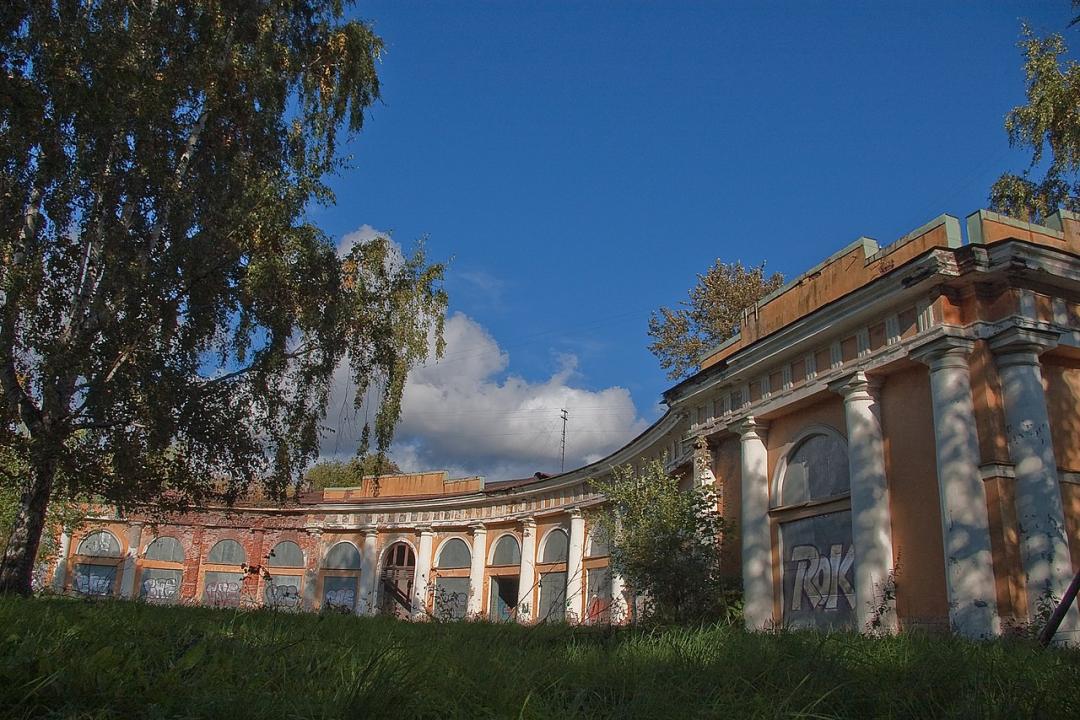
The elegant structure with a gentle dome, rounded colonnade, and wings spreading at right angles is harmoniously integrated into the natural landscape formed by the confluence of two rivers. In the corner rotunda is a circular hall, where part of the delicate ceiling stucco remains (though in a terrible state). The Utkin Dacha ensemble is completed by a courtyard service building erected in the 1820s–1830s. Two-story and curved in plan, it ends with two pavilions. The service building belongs to the high or even late classicism period. Unfortunately, there is no information about the architect of this building.
Agafokleya Alexandrovna Poltoratskaya lived permanently at the Gruziny estate (in Tver province, about 15 kilometers from the town of Torzhok), so the Okkerville estate was managed by her daughter – Agafokleya Markovna Sukhareva (by marriage), who owned the neighboring plot. The first attempt to sell the estate was made in 1814, while Agafokleya senior was still alive (she died in 1822, outliving her husband by 27 years).
In 1814, the Poltoratskys decided to sell the estate, placing an advertisement in the newspaper "Saint Petersburg Vedomosti." On December 21, 1828, the Okkerville estate was purchased by Princess Zinaida Petrovna Shakhovskaya, who, after the death of her husband, remarried, this time to the magistrate Vasily Ivanovich Utkin. Since then, the name "Utkin Dacha" became established.
In December 1828, the estate was sold to Princess Zinovia Petrovna Shakhovskaya (née Zelenkova). Her first husband was Prince A. Ya. Shakhovsky. The second was Vasily Ivanovich Utkin (future magistrate and actual state councilor), and over time the Okkerville estate became known as Utkin Dacha.
The further history of the estate is sad.
As researcher E. M. Mukhina writes, "Zinaida Petrovna died in 1870, bequeathing the estate to the Imperial Philanthropic Society. However, the dacha was to come under the society’s management only after the death of Vasily Ivanovich Utkin. From 1870 until V. I. Utkin’s death (presumably in 1872), the estate fell into decline, as it effectively had no owner. It was not possible to quickly transfer it to the Imperial Philanthropic Society because all the numerous conditions of the princess’s will had to be fulfilled simultaneously. In 1873, in the presence of Emperor Alexander II, the Okhta Mariinsky almshouse for the incurably ill and disabled was opened here. The condition concerning Utkin Dacha was fulfilled only by 1881. The Imperial Philanthropic Society organized a children’s shelter here, which shared premises with the almshouse until 1882."
With each passing year, Utkin Dacha lost its former splendor. In the 1920s, the manor house belonged to the People's Commissariat of Health of the RSFSR. It housed the Malookhtinskoye branch of the 2nd Psychiatric Hospital. In 1936, part of the premises was remodeled into apartments, and another part was occupied by the 176th children's home (an educational institution for preschoolers) of the Volodarsky district housing cooperative. In the post-Soviet era, communal apartments crowded the manor house, while the service building housed production units of the Cinema Management. Having become completely deserted in the early 2010s, the abandoned dacha suffered several fires.
In 2012, the estate, a federally protected cultural heritage site, was transferred to the State Museum of Urban Sculpture. Utkin Dacha is currently undergoing restoration.
Sources:
http://krasnakarta.ru/spot/id/18/utkinadacha
https://walkspb.ru/istoriya-peterburga/zd/utkin2
https://ru.wikipedia.org/wiki/Utkin_Dacha

