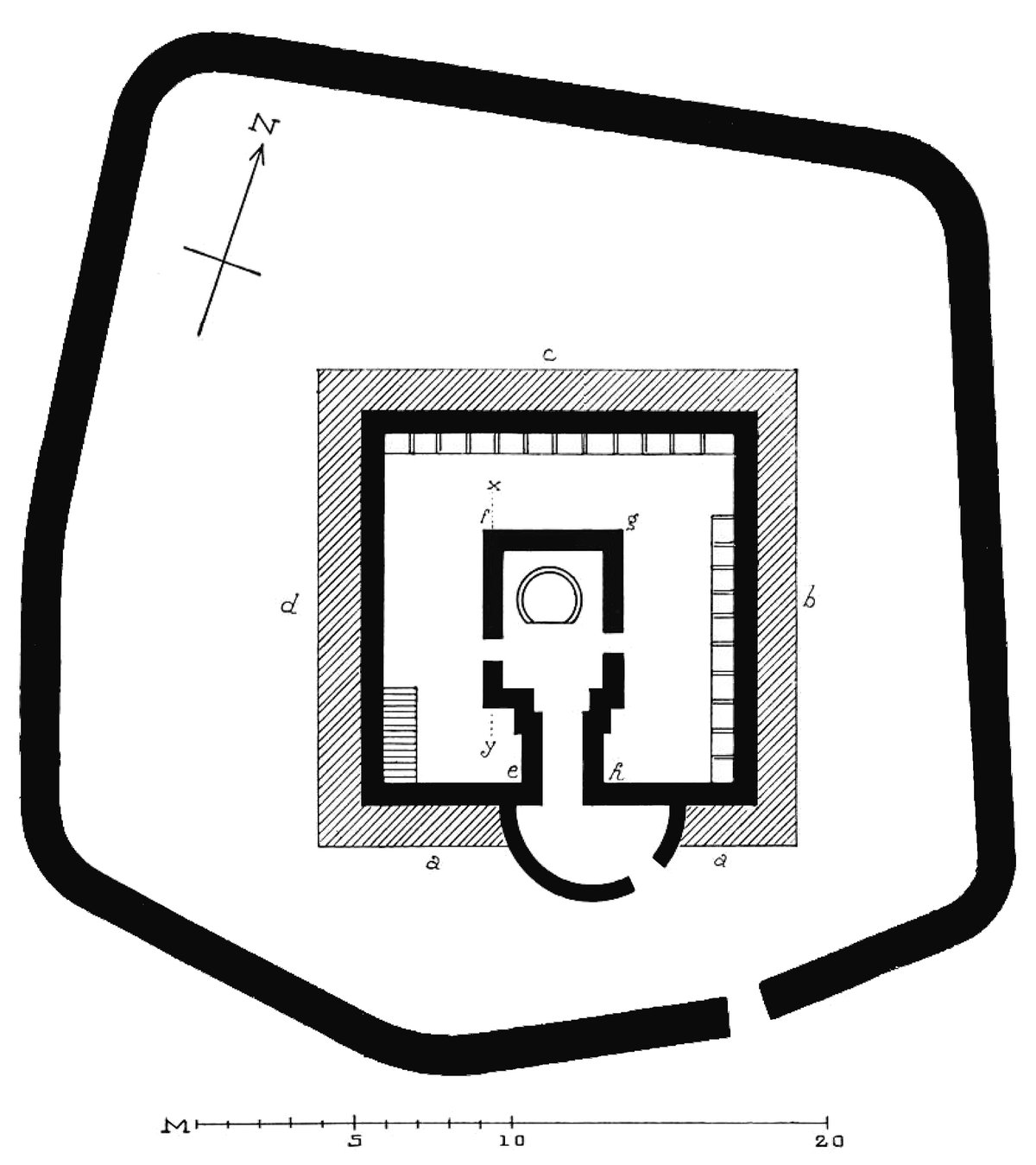
In the deserts of southern Tunisia, the ruins of Ksar Tarcine are a late Roman military fortlet. Located on a hill about 30 by 30 meters in size, the site sits above the northern bank of the Wadi Hallouf. The facility was part of a tiered system of forts and military posts along the Limes Tripolitanus in the province of Tripolitania. Today, it stands near the intersection of the C211 and C114 roads, positioned where it could observe the surrounding land and control the movement of passing caravans.
The C211 road comes from Al-Hammah and leads south toward the desert town of Ghadames. The C114 road provides access to Medenine and Tataouine to the east and southeast. While the term Centenarium is linked to a fort founded during the reign of Emperor Philippus Arabs (244–246), Ksar Tarcine is estimated to have been built around 303/305. It may have replaced an earlier outpost in the early 4th century. The archaeologist Erwin M. Ruprechtsberger suggested that many such fortifications served as fortified farmsteads, though others argue they remained military troop stations.
Between 1901 and 1902, the French archaeologist Paul Gauckler explored the Limes Tripolitanus. Leutnant Tardy of the Dienststelle für innere Angelegenheiten excavated the site at Tibubuci from December 19, 1901, to January 24, 1902. During the Roman period, soldiers dug a cistern about 50 meters below the Centenarium in the Hallouf bed to ensure a water supply. The excavation revealed a central building of 15 by 15 meters that was originally at least one story high.
The central building featured a half-circle Clavicula-Tor in the south opening to the southeast. Above the main entrance, a yellow sandstone inscription measuring 0.74 by 0.42 meters was recovered from the rubble. This entrance led to a narrow, 3-meter-long vaulted corridor ending in a rectangular open courtyard of 4.40 by 3.15 meters. At the north end of this courtyard, archaeologists found carved stone segments forming a 2-meter-diameter circle, which the excavator identified as a bench. Similar finds elsewhere suggest this might have been a shrine for the unit's standard.
Remnants of a wooden door were found providing security for the immediate entrance to the courtyard. The walls of the central structure reached up to 2.70 meters in height and were 0.80 meters thick on average. The fortlet's location allowed the garrison to monitor the arid steppe and the desert tracks. In February 2012, the Tunisian government submitted a request to have Ksar Tarcine declared a UNESCO World Heritage site as part of the Roman Limes.
Sources: Wikipedia, OpenStreetMap, Wikidata, Wikimedia Commons
Written by Mutabor
Discuss this with the author and others
No comments yet. Be the first to start the conversation.