Building of the Merchant Hotel of M. A. Alexandrov

Apraksin Lane, 6, Saint Petersburg, Russia, 191023

On April 28, 1902, Lidval signed the completed project. It was approved by the City Council on May 3. The City Council's resolution specifically noted the conditions under which the building's height could not exceed the width of Apraksin Lane, the courtyard area could not be less than 30 square sazhen (a fire safety requirement due to the need for turning horse-drawn fire engines), and the steps of the first and basement floors could not extend beyond the building line by more than 8 vershoks (35.5 cm). The latter requirement arose because the project provided for entrances to the commercial premises of the first and basement floors via steps starting from the sidewalk. To avoid obstructing pedestrians, their size had to be limited.

House No. 6 on Apraksin Lane is part of the territory that in the 1730s was granted by Empress Anna Ioannovna to her chamberlain Fyodor Andreyevich Apraksin. At the end of the 18th century, due to a fire at the Sea Market, the owners of this territory decided to sell it for merchant shops. At the same time, the part along the lane was divided into separate plots and sold to different individuals.

The eastern side of Apraksin Lane was allocated for development by imperial decree dated July 15, 1802. The address book of Petersburg in the 1820s names the owner of the plot of house No. 6 as the petty bourgeois Alexey Vasilyevich Trifonov (or Trifonov). He acquired it from the heirs of merchant Petr Shchekalov (or Chekalov). The first stone building constructed here (before 1822) was two stories, with the first floor equipped for trade with rusticated masonry (it was an open arcade). The smooth wall of the second floor was pierced by simple windows. Apparently, it was built according to the project of architect E. Dimmert, who built a very similar house next in line towards Sadovaya Street.

Initially, the width of Trifonov’s plot on the lane side was five meters wider than the width on the side of the Grafsky Drive of Apraksin’s yard. In the 1840s, the owner of the neighboring house No. 8 bought these “extra” meters, thus aligning the sides of the plots. Around the same time, Trifonov’s house was extended by adding a third floor.

All the buildings on Apraksin Lane, as well as many nearby blocks, burned down during the fire on May 28, 1862. It is obvious that house No. 6 was also damaged. By that time, it belonged to the wife of collegiate secretary Tatyana Konstantinovna Putilina. After the fire, she decided not only to restore the building but also to add a courtyard wing. The corresponding project was carried out by architect Sheleykhovsky and approved by architect Ferri de Pinye, who supervised the restoration of all buildings on Apraksin Lane. The project was retroactively approved by the General Presence of the Board of the First District of the Main Directorate of Communications and Public Buildings on October 29, 1862, when construction was already in full swing. The courtyard wing turned out to be one story higher than the construction documentation provided. On the side of Grafsky Drive, to comply with fire safety measures, almost all buildings along Apraksin Lane, including house No. 6, had blind firewall walls.

Putilina most likely rented out her house for residential and commercial shops. In 1863, a “retiring place” (architect Ferri de Pinye) was arranged in the courtyard, indicating a high likelihood of a tavern being located here.
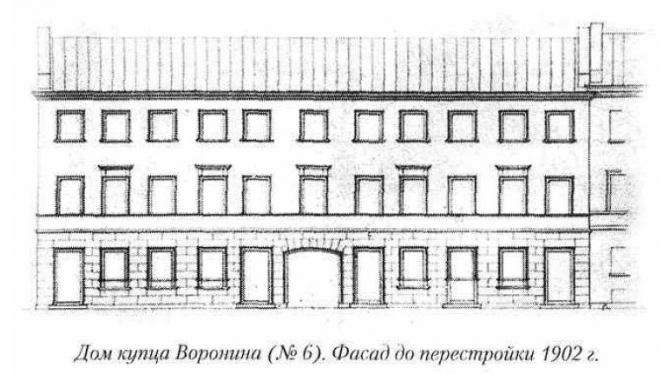

Several years later, house No. 6 passed to merchant Roman Evdokimovich Voronin. For him, the commercial premises on the first floor were expanded by replacing internal brick walls with cast-iron columns with steel beams spanning them. It was after this merchant’s surname that the passage in Apraksin Yard between houses No. 4 and 6 on the lane was named Voronikhinsky in the 1880s.

The next owner of the plot was hereditary honorary citizen Vasily Alexandrovich Khrushchev. Soon he was replaced again by Voronin, but this time by second guild merchant Pyotr Evdokimovich Voronin. He lived in house No. 32 on Gorokhovaya Street and traded in haberdashery goods in Apraksin Yard. He owned shops No. 58-59 on Grafsky Drive.

Decisive changes in the fate of house No. 6 occurred with its next owner, first guild merchant Mikhail Alexandrovich Alexandrov. He had his shops in the Small Gostiny Dvor and lived in house No. 37 on Mokhovaya Street. Merchant Alexandrov decided to erect a new building here and invited the young architect Fyodor Ivanovich Lidval. Cooperation with this architect may have been due to Alexandrov’s acquaintance with Lidval’s parents.


At the client’s request, the old building was demolished, and it was decided to erect the new structure on its foundation. On April 28, 1902, Lidval signed the finished project. It was approved by the City Administration on May 3. The City Administration’s resolution specifically noted conditions under which the building’s height could not exceed the width of Apraksin Lane, the courtyard area could not be less than 30 square sazhen (a fire safety requirement due to the need for turning horse-drawn fire engines), and the steps of the first and basement floors could not extend beyond the building line by more than 8 vershoks (35.5 centimeters). The last requirement arose because the project provided for entrances to the commercial premises on the first and basement floors via steps starting from the sidewalk. To avoid obstructing pedestrians, their size had to be limited. The resolution was signed by architect A. Shiltsov.

The first and second floors of Alexandrov’s house were intended to have seven shops. The third floor was allocated for large halls, presumably for auctions or meetings. This floor was essentially the first floor of the hotel, so one of its halls was supposed to house a restaurant. The fourth and fifth floors contained hotel rooms. The originally designed sixth floor by Lidval was not approved by the City Administration. Because of this, the architect had to submit another project for approval on August 23, which made the sixth floor an attic, not intended for living. The basement played a significant role in the project, extending even under the courtyard territory. The basement floor and ceiling were made of reinforced concrete.

The facade of Alexandrov’s house bears typical Art Nouveau features. In Lidval’s project, the pylons rising above the cornice did not intersect with the downspouts. However, this had to be done to solve problems with water drainage from the roof. The corner pylon was supposed to be topped with a hemispherical lantern under a shallow dome. This was implemented, but by 1949 only parts of the frame remained of the lantern. Between the first and second floors, suspended lanterns on brackets and guy wires were supposed to be installed. By 1949, they were no longer on the building’s facade, and their fate is unknown. By that time, flag holders existed in their place.

The hotel in house No. 6 on Apraksin Lane began operating in 1904. Historian Kirikov called it the “Merchant Hotel of M. A. Alexandrov.” However, local historian Mikishatev in the book “Walks in the Central District. From Palace Square to the Fontanka” clarifies that since 1904 the hotel owner was Vasily Vasilyevich Pudkov. The aforementioned Voronin continued to rent shops No. 71-76 on the back side of the plot until 1905. Possibly, he moved his trade to Alexandrov’s shops.

The commercial shops on the side of Grafsky Drive later became four stories. Exactly when this happened is unknown. Mikishatev suggests they were extended during the Soviet era, when Apraksin Market transformed from a trading center into an industrial zone.


From 1907, the hotel in Alexandrov’s house was owned by Nikolay Alekseyevich Kurmenev, whose family remained the owner until 1917. Since 1915, the owners of both the house and the hotel were the heirs of Alexandrov and Kurmenev.

It is obvious that during the Civil War years, the hotel and commercial premises must have been empty. At the end of the 1920s, the building was adapted for communal apartments on the upper floors and a preschool institution on the lower floors. Documentation for the re-planning of the premises was drawn up on June 22, 1930. Not earlier than this time, a third staircase was added to the building in the courtyard for the needs of the children’s institution.

Modern alterations have noticeably distorted Lidval’s original design for Alexandrov’s house facade. The first four floors here had a clear frame structure. The wall panels between the pylons were recessed under a powerful steel beam bearing the brick walls of the upper floors. Later, the highlighting of steel beams on the facade was lost. Instead of the wide display windows of the first and second floors, the building received standard windows. The doors leading to the shops on the first and basement floors were bricked up. Even the facade’s color changed. Previously, the inter-window panels of the fourth and fifth floors were darker than the rest, thus appearing as frame infill. Now the wall color is uniform. Moreover, the current owners added another floor on top of the building.

Sources:

https://www.citywalls.ru/house1058.html

https://walkspb.ru/istoriya-peterburga/zd/aleksandrova-m-a-dom


Follow us on social media

More stories from Great Architects: Fyodor Ivanovich Lidval

Lidval. Income House, the Beginning of Northern Art Nouveau in Petersburg

Kamennoostrovsky Ave., 1-3, Saint Petersburg, Russia, 197046

The works of Fyodor Lidval began to play a significant role in the architecture of Saint Petersburg in the 1900s. In the first stage of his creativity (1897–1907), he was a prominent representative of the "Northern Modern" style; his explorations during these years were close to the aspirations of Scandinavian and Finnish architects. At the same time, Lidval's buildings did not contradict the historically established appearance of the city. The Lidval tenement house, one of the architect's early works, is usually cited as an example of a residential building in this style. The Ida Amalia Lidval tenement house — the first independent work of this outstanding architect — was commissioned by his mother.

Lidval. Building of the Azov-Don Bank

Bolshaya Morskaya St., 3-5, 6th floor, office 3, Saint Petersburg, Russia, 191186

This remarkable building is located in the very center of the city, next to the Arch of the General Staff. In fact, it is two houses that were built at different, though close, times, which is also reflected in their address - Bolshaya Morskaya St., 3-5. This building was constructed for the Azov-Don Commercial Bank.

Lidval. Tolstoy House

Fontanka River Embankment, 54, Saint Petersburg, Russia, 191002

One of the legendary landmarks of St. Petersburg is the income house of Count Tolstoy, popularly known as the Tolstoy House. This huge six-story building was skillfully fitted by the builders onto a small plot by the Fontanka Embankment. The house, designed in the Northern Art Nouveau style, is distinguished by its unique facade architecture and stunning interior layout.

House of F. I. Klementz - Income House of A. I. Winter

4 Tuchkov Lane Saint Petersburg Saint Petersburg Region, Russia, 199034

This is one of Lidval's first significant works in St. Petersburg. The overall classical appearance of the building is adorned with two corner bay windows with domes, facing Kadetskaya Line and Tuchkov Lane.

Mansion of K. K. Ekval

Krasnogvardeyskiy Lane, 15, Saint Petersburg, Russia, 194100

The two-story Equal Mansion is an example of wooden "northern modernism," built in 1901 by architect Fyodor Lidval in collaboration with S. V. Belyaev. The owner of the house was the Swede Karl Equal — the owner of a cast iron foundry and mechanical plant, which was founded in 1893.

Income House of Charles de Ritz-à-Port

Malaya Posadskaya St., 15, Saint Petersburg, Russia, 197046

The income house of Charles de Ritz-à-Port on Malaya Posadskaya Street, house 15A, Built in 1910 based on the design of architect Fyodor Ivanovich Lidval.

Income House of A. K. Lemmerich

Malaya Posadskaya St., 19, Saint Petersburg, Russia, 197046

One of the buildings of a large residential complex designed by Fyodor Lidval. The five-story building was constructed in 1904. Its owner was the engineer-technologist Adolf Kazimirovich Lemmerich.

Income House of the Swedish Church

Malaya Konyushennaya St., 3, Saint Petersburg, Russia, 191186

This remarkably elegant house (Malaya Konyushennaya, house 3) catches the eye even from the Griboedov Canal embankment.

Residential building of the Evangelical Swedish Church of St. Catherine

Malaya Konyushennaya St., 1-3, Saint Petersburg, Russia, 191186

The residential building of the Evangelical Swedish Church of St. Catherine is located in the city of Saint Petersburg, on Malaya Konyushennaya Street. The building with a concert hall was constructed between 1823 and 1862, based on a design by architect Karl Karlovich Anderson. From 1904 to 1905, the building was rebuilt by architect Friedrich Johannovich Lidval.

House of N. A. Meltzer

Bolshaya Konyushennaya St., 19, Saint Petersburg, Russia, 191186

Among the income houses of the Art Nouveau era, the income house of N. A. Meltzer holds a worthy place.

The House of Yu. P. Kollan

Bolshoy Prospekt of Vasilievsky Island, 92, Saint Petersburg, Russia, 197136

The house of Yu. P. Kollan is one of the many buildings by architect Fyodor Lidval in St. Petersburg, executed in the style of Northern Modern.

Income house of I. B. Lidval and the firm "I. P. Lidval."

Bolshaya Morskaya St., 27, Saint Petersburg, Russia, 190000

In 1904, Fyodor Lidval began the reconstruction of the building, which at the time belonged to his mother, Ida Baltazarovna Lidval. Lidval's project slightly altered the overall appearance of the building — a more lavish main entrance and medallions (not implemented). A new stone staircase was constructed, the interior was rearranged, large display windows were installed, and elevators were put in place.

Income House of O. I. Libikh

Mokhovaya St., 14, Saint Petersburg, Russia, 191187

The five-story residential building of Olga Liebich was built in 1905 by architect Lidval. The building's facade is neutral with evenly distributed windows. The facade composition is asymmetrical – a bay window on the right, a risalit on the left. The decoration of the house is achieved through the selection of materials – dark gray rusticated granite on the first floor, pink-gray plaster, and a few light decorative details.

Income House of A. F. Zimmerman

Kamennoostrovsky Ave., 61, Saint Petersburg, Russia, 197022

The house belonged to the hereditary honorary citizen, engineer Arthur Fedorovich Zimmerman.

Building of the Second Mutual Credit Society

Sadovaya St., 34, Saint Petersburg, Russia, 194361

This building is one of the best examples of "Northern Modernism": a strict style that favors gray color, muted tones of other paints, massive columns, an equally massive—monolithic, like a Roman palace—facade, and small windows.

Grand Hotel Europe

Nevsky Ave., 36, Saint Petersburg, Russia, 191186

It is no coincidence that Saint Petersburg is called the cultural capital of the country; here, many magnificent buildings, palaces, and estates have been preserved, whose walls remember the feats of their owners and all the twists and turns of history. One such building is the Grand Hotel Europe, the oldest hotel in Saint Petersburg, located in the very heart of the city, at the corner of Nevsky Prospect and Mikhailovskaya Street.

Houses of Charles de Richeport

Malaya Posadskaya St., 17-1, Saint Petersburg, Russia, 197046

At Ritz-à-Porter, a complex of income houses was built over several years on the site of the factory territory, which radically changed the character of the development of this part of the street. The designs of all the houses were created by architect Fyodor Lidval. The first building, constructed at the beginning of the 20th century (the current house No. 17, lit. A), was erected on the site of two-tier wooden warehouses of the cast iron foundry. Apartments here were rented out for a year and for longer terms.

M. A. Gorchakov Mansion - House of the Oil Production Partnership "Brothers Nobel"

Griboedov Canal Embankment, 2 lit. A, Saint Petersburg, Russia, 191186

The famous architect Fyodor Lidval actively collaborated with the Nobel family, designing and remodeling buildings of various purposes at their request. And this collaboration began with the building of the House of the Petroleum Production Partnership "Brothers Nobel."

E. L. Nobel Mansion - M. L. Oleynikova Mansion

Lesnoy Ave., 21-1, Saint Petersburg, Russia, 194044

The mansion was built between 1902 and 1904 by architect Melzer Robert-Friedrich (Roman Fyodorovich) and military engineer Melzer Ernest Fyodorovich, and was rebuilt in 1910 by architect Lidval Fyodor Ivanovich.

Income House of Emmanuel Ludwigovich Nobel

Bolshoy Sampsoniyevsky Ave., 27, Saint Petersburg, Russia, 194044

The Income House of Emmanuel Ludwigovich Nobel is an architectural monument and is part of the Residential Complex for employees of Ludwig Emmanuelovich Nobel's factory. The house was built in 1910–1911. The large gray house in Art Nouveau style closes off the Residential Complex of the "Ludwig Nobel" factory from the side of Lesnoy Avenue.

Hotel "Astoria"

Bolshaya Morskaya St., 39, Saint Petersburg, Russia, 190000

"Astoria" (since March 1916 — "Petrograd Military Hotel"; since September 1918 — "First House of the Petrograd Soviet"; since 1924 — "First House of the Leningrad Soviet"; since February 1991 — "Astoria") is a five-star hotel in Saint Petersburg, located in the city center on St. Isaac's Square next to St. Isaac's Cathedral.

Income House of G. F. Eilers — Former Property of the Flower Magnate

4a Rentgen Street, Saint Petersburg, Russia, 197101

On the Petrograd Side stands an elegant building in the style of Northern Modernism — an income house belonging to second guild merchant Herman Eilers. It was specially built in 1913 for the merchant and his family. Eilers was the owner of an entire floral empire in the city; his shops were even mentioned in the poems of Mayakovsky and Agnivcev. Almost a century later, the house, thanks to its unusual appearance, appeared in the films *An Unfinished Story* and *Brother*.

Income House of S. M. Lipavsky

Bolshoy Prospekt P.S., 39, apt. 8, Saint Petersburg, Russia, 197198

The house was built for professors of the Medical Institute. It was equipped with an elevator (starting from the level of the 2nd floor (residential)), plumbing, electric lighting, and a coal boiler room with a very efficient steam heating system.

The Mansion of S. N. Chaev

9 Rentgen Street, Saint Petersburg, Russia, 197101

The mansion, featuring the characteristic variety of textures typical of Art Nouveau, relief friezes inspired by antiquity, elegant decor in the style of the Vienna Secession, and an extraordinary spatial design with a winter garden rotunda, ranks among the finest works of St. Petersburg Art Nouveau.

Residential building for employees of the Azov-Don Bank.

Professora Popova St., 41/5, Saint Petersburg, Russia, 197376

One of the most famous works of architect Fyodor Ivanovich Lidval is the building of the Azov-Don Bank. However, not everyone knows that there is another building in our city created by Lidval for this bank. It is a house for the employees of the Azov-Don Bank. The building was constructed in 1914-1915 and became one of Lidval’s last works in Petersburg.

Building of the Russian Bank for Foreign Trade

Professora Popova St., 41/5, Saint Petersburg, Russia, 197376

In 1915–1916, at the address Bolshaya Morskaya Street, No. 18 (No. 5-7 Kirpichny Lane, No. 63 on the Moika River Embankment), construction of a building for the bank was started (but not completed due to the revolution) based on a design by architects Fyodor Lidval and Leonty Benois. However, currently, this building, completed in 1929–1931, houses the State University of Technology and Design.

The Azov-Don Bank building in Astrakhan

Nikolskaya St., 3, Astrakhan, Astrakhan Oblast, Russia, 414038

The Azov-Don Bank building was constructed in 1910 based on a design by architect Lidval. It was located on Nikolskaya Street, where shops, hotels, tenement houses, and various offices were situated. The bank building was built in the style of Russian neoclassicism, which had developed by 1910. This style was oriented towards the later generation of Western European neoclassicism, which interacted with the neo-romantic direction of northern modernism. This variant of "international" neoclassicism was characterized by monumentality, the use of granite cladding, and a "torn" surface of stone masonry. It was especially popular in the construction of bank buildings, symbolizing conservatism, reliability, and stability.

The building of the Azov-Don Commercial Bank in Saratov

43 Maksima Gorkogo St., Saratov, Saratov Oblast, Russia, 410003

Azov-Don Bank is the only building in Saratov constructed according to the design of the greatest master of St. Petersburg Art Nouveau, Fyodor Lindvall.

The building of the Russian Bank for Foreign Trade: "Italian House" on Khreshchatyk

Khreshchatyk Street, 32, Kyiv, Ukraine, 01001

The building of the Russian Bank for Foreign Trade at 32 Khreshchatyk Street is an architectural monument. This rare structure in Kyiv’s urban landscape is designed in the "Northern Modern" style. This elegant four-story building is part of a small complex of imperial-era structures that survived on Khreshchatyk during World War II. Architecture experts sometimes refer to the building as “Italian.” This is due to its decoration — the building’s ornamentation somewhat resembles Palazzo Strozzi, a masterpiece of Renaissance architecture located in Kyiv’s sister city, Florence. The author of this Kyiv masterpiece is the St. Petersburg architect Fyodor Lidval, and the sculptural decoration of the facade was created by the sculptor Vasily Kuznetsov.

The Azov-Don Bank building in Kharkiv

Constitution Square, 12, Kharkiv, Kharkiv Oblast, Ukraine, 61000

The Azov-Don Bank, founded in 1871 in Taganrog, was one of the largest banks in the empire. Over time, the bank began to experience a shortage of space, so in 1914 it moved to a new building at 18 Constitution Square (architects F. Lidval, L. Terven).

Building of the Omsk Railway Administration

Karl Marx Ave., 35, Omsk, Omsk Region, Russia, 644042

The former building of the Omsk Railway Administration, now comfortably housing the Omsk State University of Railway Engineering, is located on Marx Avenue. This building is an architectural monument from the early 20th century. The facade was designed by Fyodor Lidval, a renowned architect from Saint Petersburg. The "highlight" of this project is the four tall columns supporting the pediment. At their tops are four sculptures symbolizing Track, Traction, Movement, and Management.

A house for bachelors in the city of Lysva

Sovetskaya St., 17, Lysva, Perm Krai, Russia, 618900

The architect of this building is F.I. Lidval. For single professionals, he designed a beautiful and convenient three-story Bachelor’s House. The building was constructed over the course of two years. From 1917 to 1920, the first Council of Workers and Soldiers' Deputies worked here. Today, the Lysvenskoye Department of Internal Affairs is located here.

House of the company "Shell," Stockholm

Birger Jarlsgatan 64, 114 29 Stockholm, Sweden

The developer of the building is Svensk-Engelska Mineralolje AB, and the architectural firm of Albin Stark was the company that created a somewhat unusual design. However, the author of the building is not entirely clear. All the drawings submitted to the Building Committee are signed by Albin Stark, but there are many indications that most of the work was done by Fredrik Lidvall (Fedor Lindvall).

Income Houses of the Joint-Stock Company "New Petersburg"

Zheleznovodskaya St., 19, Saint Petersburg, Russia, 199155

Income house of the joint-stock company "New Petersburg," part of the project for the development of the territory in the western part of Goloday Island (Decembrists' Island). Designed in 1911-13 by architect I. A. Fomin with the participation of architect F. I. Lidval. The project for the large residential area is based on the characteristic radial-ring system typical for St. Petersburg.