
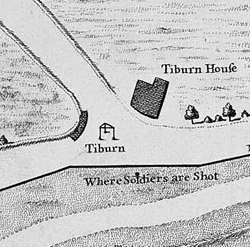
Tyburn’s execution site, known as 'the Elms,' was a spectacle of mass punishment. From 1196 to 1783, tens of thousands of people - traitors, highwaymen, and religious dissenters - were hanged, drawn, and quartered at the Tyburn Tree, a triangular gallows capable of holding 24 prisoners simultaneously. The 1649 execution of 24 prisoners - 23 men and 1 woman - marked one of the most dramatic mass hangings in English history. Crowds of 50,000 or more gathered for public processions from Newgate Prison through St Giles in the Fields, with the condemned paraded to the gallows on the Tyburn Brook. Notable victims included William Fitz Osbern (1196), a rebel baron, and Perkin Warbeck (1499), a pretender to the English throne. Oliver Cromwell, the regicide who oversaw the execution of King Charles I, was posthumously hanged in 1661, his body dismembered and buried near the site. The last public hanging occurred on 3 November 1783, when John Austin, a highwayman, was executed by the Tyburn Tree, ending an era of public spectacles. The gallows, known as the 'Triple Tree,' was dismantled in 1783, and a plaque now marks the site near Marble Arch, within Hyde Park. The site’s name derives from the Tyburn Stream, a boundary between London and Middlesex, though its origins remain debated. Today, the area is a quiet intersection, but the echoes of its grim history linger in the plaque and the name of the nearby Edgware Road and Bayswater Road junction. The site’s legacy is etched in the records of 100 annual hangings until 1783, with the gallows itself becoming a symbol of both terror and the shifting tides of public sentiment toward capital punishment.
Written by Nik Frost
Discuss this with the author and others
No comments yet. Be the first to start the conversation.