Saw tower

Krasnogo Molodtsa, Saint Petersburg, Russia, 196625

The Saw Tower is one of the poetic pavilions in the park, designed in a pastoral-romantic style. The pavilion was a tribute to the fashion of its time and served as a place for brief rest during a long walk through the park.


The Peel Tower is one of the poetic pavilions in the park, designed in a pastoral-romantic style. The pavilion was a tribute to the fashion of its time and served as a place for brief rest during a long walk through the park. The tall two-story pavilion of Pavlovsk Park was conceived as an original architectural work in the style of “romantic poverty.” At the turn of the 18th-19th centuries, when the tower was designed and built, it was fashionable to create modest exteriors with a pretension to poverty, while decorating the interiors in a royally luxurious manner. The exterior of the building is painted with patterns imitating brickwork at the bottom and wooden cladding at the top, and the roof is covered with ordinary straw. An additional external staircase leads to the second floor — the Romanovs preferred to enter the room through the balcony, bypassing the service areas. The pavilion’s plan was developed by Pietro Gonzago, and its realization was assisted by Vincenzo Brenna, architect Schreter, and stonemason Visconti.
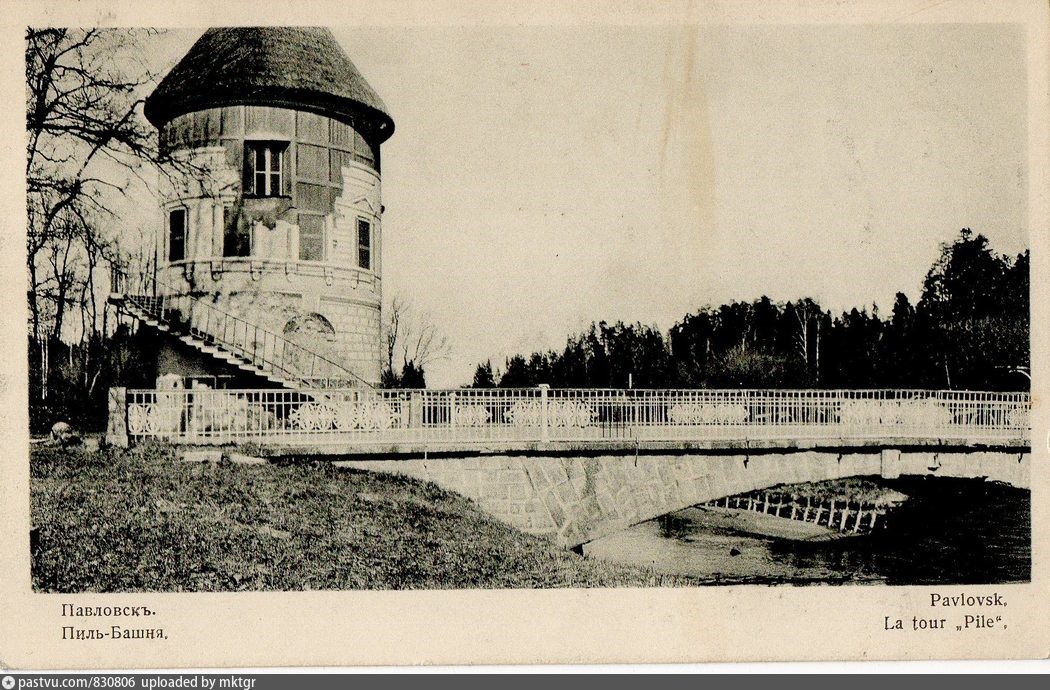

According to one version, the name of the tower comes from a sawmill that once stood on its site; according to another, it derives from the English “peel tower”: in Britain in the 15th century, watchtowers were called this.

The first floor, during the time of Paul I, served as quarters for servants, where, according to legend, misbehaving and negligent pages were confined. The Peel Tower is one of the most expressive buildings in Pavlovsk, resembling a miniature castle.

The second floor was used by the owners themselves: it was exquisitely and fabulously furnished, decorated with stucco and paintings by famous artists. Unfortunately, part of the decor was lost, but after restoration work, the interior of the late 18th–early 19th century was successfully imitated on the second floor. The room featured a fireplace, above which was a plaster relief and a large mirror; the floor was laid with expensive oak, and the walls were covered with Chinese fabrics. Currently, temporary exhibitions are held on the second floor, but only in the summer, as the pavilion is not heated.

Built on the bank of the Slavyanka River according to Brenna’s design in 1797, the pavilion impressively opens up from various scenic viewpoints. The Peel Tower is a round structure with a conical roof covered with straw. Its walls were painted by Gonzago, creating the illusion of a partially ruined building. On one side of the tower, a rickety staircase led to the second floor.

At the foot of the tower is a wooden bridge with a decorative watermill. The noise of the mill wheels and the splash of water complemented this rural idyll. Nearby was also a small summer bathing house. It is no coincidence that landscapes featuring the Peel Tower were favorite subjects of 18th-century artists.

In 1808, instead of the dismantled watermill, A.N. Voronikhin built a new Peel Tower Bridge with a beautiful gentle arch over the water and cast-iron railings. In the summer of 1808, Sukhanov’s team carried out “cutting of Chernitsky stone planks, laying them in place with lime mortar, fastening each piece with clamps, nails, and pouring lead over them.”

During the Great Patriotic War, the bridge was blown up, and the pavilion building was severely damaged. They were restored in the 1960s-70s.

Sources:

https://www.spb-guide.ru/page_20044.htm

http://www.pavlovskmuseum.ru/about/park/layout/39/1151/

https://tonkosti.ru/%D0%9F%D0%B8%D0%BB%D1%8C-%D0%B1%D0%B0%D1%88%D0%BD%D1%8F

https://www.votpusk.ru/country/dostoprim_info.asp?ID=10127

Follow us on social media

More stories from Samson Sukhanov: Master of Stonework

Secrets of the Alexander Column

Palace Square, 6, Saint Petersburg, Russia, 191186

The Alexander Column, which stands in the middle of Palace Square, was erected to commemorate the victory over the French in 1812.

House of the Master of Stone Works

nab. reki Pryazhki, 50, Saint Petersburg, Russia, 190121

In a quiet corner of historic Petersburg, on the embankment of the Pryazhka River, stands house No. 50.

House of the Stoneworks Master

nab. reki Pryazhki, 50, Saint Petersburg, Russia, 190121

In a quiet corner of historic Petersburg, on the embankment of the Pryazhka River, stands house No. 50.

Voronikhin Colonnades of Peterhof

Razvodnaya St., 2, Saint Petersburg, Russia, 198510

How bright, how emerald-dark In the shade of its dense gardens, And how sparkling, and how transparent Is the water-dripping Peterhof.” P.A. Vyazemsky

Saw Tower

Krasnogo Molodtsa, Saint Petersburg, Russia, 196625

The Saw Tower is one of the poetic pavilions in the park, designed in a pastoral-romantic style. The pavilion was a tribute to the fashion of its time and served as a place for brief rest during a long walk through the park.

The Hanging Garden and the Stairway of the Gods in Tsarskoye Selo

Catherine Park / Catherine Park, Saint Petersburg, Russia, 196601

An unusual monument of classical architecture, resembling the romantic ruins of an ancient Roman bridge

Kazan Cathedral - import substitution

Kazan Square, 2, Saint Petersburg, Russia, 191186

This marks the beginning of the golden period of Russian architecture, and Petersburg finally takes on the appearance of the capital of a great empire. Nevsky Prospect becomes not just a "perspective." One of the largest cathedrals in Saint Petersburg. Built on Nevsky Prospect between 1801 and 1811 by architect Andrey Voronikhin in the style of Russian classicism to house the revered copy of the miraculous icon of the Kazan Mother of God. After the Patriotic War of 1812, it gained significance as a monument to Russian military glory. In 1813, the commander Mikhail Illarionovich Kutuzov was buried here, and the keys to captured cities and other military trophies were placed inside. The cathedral gave its name to Kazanskaya Square, Kazanskaya Street, Kazansky Island in the Neva delta, and the Kazansky Bridge at the intersection of Nevsky Prospect and the Griboedov Canal.

Physical Cabinet or Masonic Sanctuary of Count Stroganov

Nevsky Ave., 17, Saint Petersburg, Russia, 191186

Doctor of Historical Sciences, Professor Kuznetsov, in the book *"The Stroganov Palace,"* suggested that besides the alchemical laboratory, a Masonic lodge gathered in this study. There was a Masonic sanctuary, and the Commission for the Construction of the Kazan Cathedral held its meetings there.

Mountain building (school, institute)

Lieutenant Schmidt Embankment, 49, Saint Petersburg, Russia, 199034

The Mining School — the oldest higher technical educational institution in Saint Petersburg — was founded by the decree of Catherine II on October 21 (November 1), 1773.

Arrow of Vasilievsky Island

Birzhevaya Square, Saint Petersburg, Russia, 199034

The Strelka of Vasilyevsky Island is the calling card of Petersburg. Everyone who falls under the charm of this place loves to take photos near the huge granite spheres crowning the descents to the water. The eastern tip of the Strelka was decorated by architect de Thomon with a descent to the Neva and adorned with elegant, gently sloping granite ramps. Flowing smoothly around the Rostral Columns, they descend right to the water. At the very water’s edge, on pedestals, rest stone spheres astonishing in their perfection. It is said that master stonemason Samson Xenofontovich Sukhanov carved these geometrically precise spheres by eye, without using any measuring instruments and almost with a single strike.

Tsar bathtub

Krasnoselskoe Highway, 85, Saint Petersburg, Russia, 196603

This work by a Russian artist deserves even more attention, as since the time of the Egyptians nothing so colossal made of granite is known.

Admiralty Needle

Admiralteysky Lane, 1, Saint Petersburg, Russia, 190195

The Admiralty in Saint Petersburg is one of the most famous and beautiful landmarks of the Northern capital.

The House with Lions – An Introduction to Monferrand

1 Voznesensky Ave, Saint Petersburg, Russia, 190000

The first completed building by Monferrand in the Russian capital was the Lobanov-Rostovsky House, or the House with Lions, on Admiralty Prospect. It was during the construction of this house that Samson Sukhanov met the future creator of St. Isaac's Cathedral.

House with Lions – Introduction to Monferrand

1 Voznesensky Ave, Saint Petersburg, Russia, 190000

The first completed building by Monferrand in the Russian capital was the Lobanov-Rostovsky House, or the House with Lions, on Admiralty Prospect. It was during the construction of this house that Samson Sukhanov met the future creator of St. Isaac's Cathedral.

St. Isaac's Cathedral - the beginning of the ruin of the master stoneworker

Isaakievskaya Square, 4, Saint Petersburg, Russia, 190000

Sukhanov delivered only eleven columns; the commission for the construction of St. Isaac's Cathedral awarded the contract for the manufacture of the remaining columns to Arkhip Shikhin, violating the agreement with Sukhanov and thereby causing him irreparable losses. The construction of the cathedral was completed in 1858. In the same year, Auguste Montferrand passed away. Samson Sukhanov was unable to fulfill several contracts and went bankrupt. The master died in obscurity and poverty even before the completion of the cathedral's construction.

St. Isaac's Cathedral - the beginning of the ruin of the master of stonework

Isaakievskaya Square, 4, Saint Petersburg, Russia, 190000

Sukhanov delivered only eleven columns; the commission for the construction of St. Isaac's Cathedral awarded the contract for the manufacture of the remaining columns to Arkhip Shikhin, violating the agreement with Sukhanov and thereby causing him irreparable losses. The construction of the cathedral was completed in 1858. In the same year, Auguste Montferrand passed away. Samson Sukhanov was unable to fulfill several contracts and went bankrupt. The master died in obscurity and poverty even before the completion of the cathedral's construction.

The Benefactor Husband or The Mausoleum of Paul I

Saint Petersburg, Russia, 196625

The Mausoleum of Paul I is not the emperor’s tomb. Paul I, like all members of the imperial family, is buried in the Peter and Paul Cathedral in Saint Petersburg. In one of her letters, Empress Maria Feodorovna refers to it as a "Monument," and in the contract with the architect Carlo Domenico Visconti, she calls it a "Temple." The modern name is "To the Benefactor-Spouse" or "Mausoleum of Paul I."

Fountain "Four Sphinxes" or "Four Witches"

Pulkovskoye Highway, 74, Saint Petersburg, Russia, 196140

At the corners of the rectangular pedestal stood sphinxes, which had "the body of a lion and the head and chest of a girl." Many architects believed that "in terms of originality and artistic value, the Tomonovsky fountain with sphinxes near Pulkovo Hill is unparalleled." The sphinxes were also made of granite; earlier they appeared to be bronze, then, when they turned green from dampness and were covered with moss, the locals nicknamed them the "Fountain of Witches" or the "Four Witches." Now they have been cleaned, but the name has stuck.

Molvinskaya Column

Liflyandskaya St., 12, Saint Petersburg, Russia, 198099

At the entrance to Yekateringof Park stands a six-meter column made of red granite—a work by Auguste Montferrand. On the grounds of the current 19th-century St. Petersburg park "Yekateringof," the only preserved monument is the six-meter Molvinskaya Column, located on the right bank of the Tarakanovka near the Molvinsky Bridge. The monument appeared on the territory of Yekateringof Park in the summer or early autumn, but no later than November 1824.

Rostral Columns

Birzhevaya Square, 1 building 2, Saint Petersburg, Russia, 199034

One of the symbols of Saint Petersburg is an integral part of the ensemble of the Spit of Vasilievsky Island. Two rostral columns were erected between 1805 and 1810 according to the design of the French architect Thomas de Thomon, who decorated them with ship prows on both sides of Vasilievsky Island.