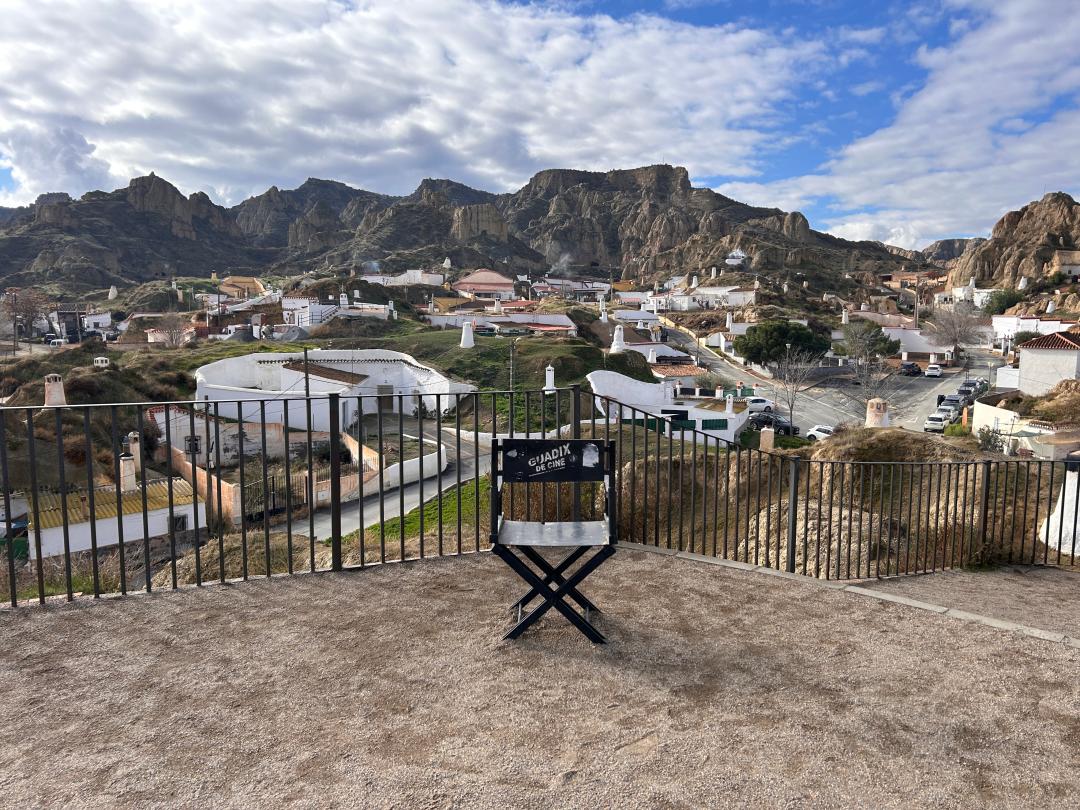
Guadix has long been a magnet for filmmakers seeking landscapes that feel mythic, untamed, or timeless. Walk through the town today and you’ll find it quietly marked as a cinematic atlas: six director’s chairs are placed at key viewpoints — near the cathedral, by the old sugar factory, at the railway station, by the Gate of Torcuato, in Santiago Square, and at a mirador in the Barrio de las Cuevas — each one framing a scene immortalised on film and inviting visitors to sit and see Guadix as directors once did.
The earliest known production here dates back to 1924, and since then more than a hundred audiovisual works have used Guadix’s varied terrain, cave homes, historic streets, and surrounding badlands as their backdrop.
The town and its environs have doubled for distant worlds far beyond southern Spain. In the spaghetti western heyday, directors exploited the arid terrain and architectural textures here and in the surrounding basins; films such as For a Few Dollars More, The Good, the Bad and the Ugly, and A Fistful of Dynamite used the area’s edges to stand in convincingly for the American frontier.
But Guadix’s cinematic résumé doesn’t stop at dusty gunfights. Indiana Jones and the Last Crusade shot sequences at the old train station, transforming it into the bustling port of Iskenderun and drawing more than 170 local extras. Other notable productions include Karol, un hombre que llegó a ser Papa (2005), which used the city’s historic core and neighborhoods to evoke scenes set in Central America and Mexico.
More recently, NBC’s fantasy series Emerald City turned Guadix into a reimagined Oz. The show used the cave district and surrounding landscapes to create otherworldly settlements and fantastical vistas. Guadix’s natural contours — the eroded hills, ravines, and subterranean homes — provided a ready-made fantasy canvas, proving that reality here is strange enough to feel like fiction.
What unites all these works is Guadix’s chameleon-like versatility — its cave homes can be frontier encampments, its plazas can become 19th-century stations, its streets can stand in for towns half a world away. And at each of the six director’s chairs, you can literally sit where storytellers once tested a frame, imagining something new out of stone, shadow, and horizon.