

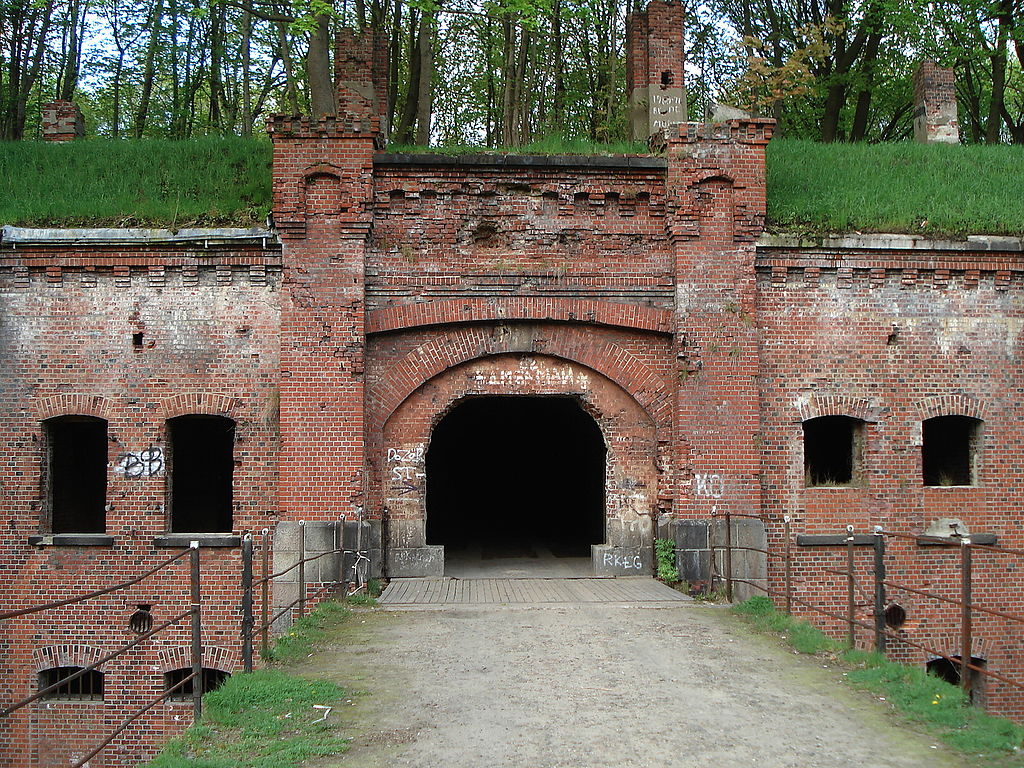
Fort No. 6 "Queen Louise" (Konigin Luise bei Juditten) is one of the forts of the inner defensive ring of Königsberg.
The fort covered the railway and highways to Pillau (Baltijsk). It was built in 1875 and was a small fortress surrounded by a dry moat, with the necessary set of ravelins, escarps, counterscarps, and other achievements of fortification science, allowing it to repel enemy attacks for several months. The object is architecturally interesting — the "Queen Louise" bastion is three stories high, constructed using red and yellow bricks. The structure was almost unharmed during the assault and is well preserved to this day.
After construction was completed, due to improvements in offensive weapons and combat tactics, the entire system of Königsberg forts underwent several upgrades and strengthening of defensive functions. The last improvements were made in the 1930s-40s.
During World War II, Fort No. 6 was not damaged. According to veterans who participated in the storming of Königsberg, the first to assault Fort No. 6 was a penal battalion. All its soldiers died in a short time. Then scouts took part in the assault. The heroes met the same fate. It became clear that an assault without serious artillery preparation on such a fortified object would lead to heavy losses. But the unexpected happened — the fort's garrison raised a white flag and surrendered.
Memories of the assault participants:
Karsanov K. D. "The Guards Mortars Are Firing"
On April 7, the 13th Rifle Corps of the 43rd Army encountered heavy fire from Fort No. 6, known as "Queen Louise," which towered in the urban district of Marienberg. The artillery commander decided to strike the fort with fire from two mobile divisions that had just deployed in the sector of the 13th Guards Rifle Corps. The division commander quickly clarified the target coordinates, marked them on the map, and relayed them by radio to the division commanders of the guards, Majors Oksov and Vyrvikhvost.— "Ready to report!" — he ordered. — "Keep radios on receive!" Not even fifteen minutes passed before they reported readiness to open fire. The simultaneous salvo of two divisions — totaling 288 heavy rocket shells — precisely hit the fort. Through the hail of explosions, the division commander observed all the upper caponiers of the fort collapse, a brick wall with an iron fence surrounding the inner courtyard fall. The assault squads immediately took advantage of this. They blocked the fort. Its garrison was forced to surrender.
Mikhail Yakovlevich Vorobyov
On April 8, 1945, Nikolai Yakovlevich, commanding a penal company and a reconnaissance platoon, almost without a fight forced the enemy to open the gates of the "Queen Louise" fort, where 350 Germans were captured. The commandant surrendered his Walther pistol to him. The capture of this important object was reported by telephone to the division commander, Colonel Dulov, who immediately appointed the brave major as the fort's commandant until the arrival of the regiment commander. For this operation, N. Vorobyov was awarded the Order of the Red Banner. In total, he had six orders and three medals. He also received awards in peacetime — Nikolai Yakovlevich devoted his entire life to the army. However, one misunderstanding is connected with the capture of the "Queen Louise" fort. Much later, after reading a lot of literature about the war, Nikolai Yakovlevich found in the "History of the Great Patriotic War" a description of the capture of the aforementioned fort. According to the book, the credit belonged to... the brother of Zoya Kosmodemyanskaya — Alexander. It turns out that the battery under his command, "despite dense blocking fire and minefields, took an open position in front of the 'Queen Louise' fort. After firing at the fort, it broke the gates and rushed into the courtyard. The fort's garrison capitulated. 350 prisoners, 9 tanks, fuel depots, and 200 vehicles were captured."
Nikolai Vorobyov was upset by such distortion. It was politically advantageous to show the Kosmodemyanskaya family's patriotism. He personally knew Alexander and did not diminish his bravery and merits. But historical events should not be presented to descendants in a distorted form, especially since there are still many living witnesses of the fort's capture. He then wrote letters to the Institute of Marxism-Leninism under the CPSU Central Committee, to the editorial office of the newspaper "Red Star," telling how it really happened. But appeals to high authorities ended, so to speak, in nothing...
Vladimir Petrovich Mironov
By decree of the Presidium of the Supreme Soviet of the USSR dated April 19, 1945, Vladimir Petrovich Mironov was awarded the title Hero of the Soviet Union with the Order of Lenin and the Gold Star medal.
...And Vladimir Petrovich's combat feat was exceptionally unparalleled. He single-handedly forced the garrison of the powerful Fort No. 6 "Queen Louise" near Königsberg to surrender. Here's how it happened: at the end of March 1945, the powerful offensive of the troops of the 3rd Belorussian Front suddenly stumbled at the approaches to the fascist stronghold on the Baltic — Königsberg. The fortress was prepared for a prolonged defense. It could hold out for many months in complete isolation if necessary. The strongest fortifications, underground power plants, numerous ammunition and food depots. And behind them — Germany. Where to retreat? And the fascists resisted desperately. The approaches to the city were reliably covered by engineering structures. One of them — Fort No. 6 "Queen Louise" — stood in the way of the 1344th Order of Kutuzov Rifle Regiment, where Private Vladimir Petrovich Mironov served as a machine gunner. The "nut" was hard to crack. The underground casemates were made of granite and reinforced concrete back in 1871-1875. The fort was a huge closed ring six meters high, bristling with gun and machine gun barrels. In its center was a parade ground with the tops of pillboxes. Two powerful steel gates. From the fort, a straight concrete highway led to Königsberg. The regiment had been assaulting the fortifications for two days but unsuccessfully. The main caliber artillery fired on them, aviation struck from the air. But as soon as the soldiers rose to attack, they were met with a hail of fire. The command decided to bring self-propelled guns into direct fire to blast the steel gates with shells. After the artillery strike, Mironov, with a handful of soldiers and a light machine gun, burst onto the fort's parade ground. Every meter was under fire here too. Soldiers fell, cut down by bullets, and he rushed to the concrete near the pillbox. Two grenades were rolled by the soldiers into the roaring embrasure. The pillbox fell silent. But at that moment, a powerful artillery strike was made on the fort. Fire raged again on the fortifications and parade ground. Then Mironov suddenly noticed a niche in the wall with a door. To escape the fire, he dashed there and opened the door. No one was inside. A long corridor, electric light. And he was alone, like a lit target. He noticed more doors. He tore a grenade from his belt, pulled the pin, and kicked the door open:
- Hände hoch, bastards!
The faces of the officers stretched out, their hands went up. Mironov nodded toward the door. The officers began to come out. One of them took the banner standing there. They were accompanied out by Private Mironov. Already on the parade ground, the German turned and threw the banner at the soldier's feet. The fortress seemed to awaken. Soldiers and officers began to come out of its casemates and pillboxes. They threw their weapons into a pile. Mironov did not remember how long it lasted. Then he saw our soldiers flood through the broken gates of the fort. How the regiment commander's "Willys" jeep burst onto the parade ground. It turned out later that Mironov captured the fortress commandant and the chief of staff along with the unit banner. That is why the German soldiers laid down their arms without resistance.
Like any other Königsberg fort, "Queen Louise" is surrounded by an aura of mystery. "Absolutely reliable" information about treasures stored there is passed from mouth to mouth. It is hard to say to what extent it can be trusted.
Local historian Avenir Ovsyanov, in the book "In the Casemates of the Royal Fort" (12+), writes that in 1979, the magazine "Freie Welt" (former GDR) received a letter from a certain Hans Schreiber from Weißenfels, who was captured in April 1945 after the surrender of Fort No. 6. "I remember that in the last days of March 1945, cargo trucks from unknown military units arrived at the fort, loaded with crates. The arriving soldiers carried the crates inside the fort. Among us, the fort's garrison, there were rumors about valuables and documents buried in the fort. I know that the crates were not taken out of the fort afterward, as it was soon taken by the Russians. I cannot name other witnesses because I served in a hastily formed unit. I also remember that in some casemates of the fort lay those killed before the assault. The fort had a hospital, and the outer side of the fort beyond the moat was a terrible place. Deserters were shot there," the historian quotes Hans Schreiber.
He also reports that, according to the memories of the fort's assault participants, in 1947, a large number of powder cans, a bicycle, clothes, shoes, containers with various drinks, boxes with short propaganda films, medicines, and remnants of broken crystal and porcelain were found in the fort. Some casemates showed traces of fire: ashes, scraps of some archival sheets. Undestroyed ammunition was still in a case.
Hans Schreiber's letter was handed over to the Kaliningrad Geological and Archaeological Expedition. But, as far as is known, its specialists found nothing interesting in the fort. And this is generally not surprising. After the war, the relatively undamaged fortification was, so to speak, open to the public and was not guarded. One of the heroes of the book by writer Yuri Ivanov "Dances in the Crematorium" (18+), set in the just-captured Königsberg, tells how he emptied a whole pistol magazine in the casemates of "Queen Louise." A common pastime in those days...
Only in the early 1950s did the Baltic Fleet services settle in the fort. Now the fort, as already mentioned, is still "in service." According to Roman Martov, head of the Baltic Fleet Information Support Department, the military currently have no plans to abandon this object. It is now the Baltic Fleet Command Post. Access is possibly only to the inner courtyards.
Sources:
https://urban3p.ru/object10486
https://www.forum-kenig.ru/viewtopic.php?f=41&t=1386



Written by Jermaine
Discuss this with the author and others
No comments yet. Be the first to start the conversation.