The Mennonite Church - "Community House"

27 Pobedy St., Neman, Kaliningrad Region, Russia, 238710

The "Community House" of the Mennonites in Ragnit was built in 1853. This once beautiful building, constructed in the late Romanesque style, was originally a prayer house for the largest Mennonite community in the territory of the present Kaliningrad region.

“The Mennonite Community House” in Ragnit was built in 1853. This once beautiful building, constructed in the late Romanesque style, was originally a prayer house for the largest Mennonite community in the territory of the present-day Kaliningrad region. Mennonites are a branch of Protestants. The building has a total area of 1,128.4 square meters.

Mennonites are one of the Protestant sects, named after their founder, Simon Menno. The Mennonites successfully combined deep religiosity with a high level of technical culture, which was reflected both in architecture and in the use of various progressive technologies of that time. For example, Tilsit cheese also owes its origins to the Mennonites. It was produced in East Prussia since the time of the Teutonic Order. The Mennonites brought their recipes to Prussia, and the fusion of Dutch and Swiss recipes became the basis for a new type of cheese. But the story of Tilsit cheese will be told separately.

The solid structure of the Ragnit Community House was built from brick and faced with stone. Its exterior strongly resembles the 13th-century order churches. The building did not serve long as a prayer house. Six years after it was built, the Mennonites sold the building to the city. At that time, Mennonite communities in East Prussia faced many difficulties. Authorities often denied them in various matters, there were problems acquiring land plots, and simultaneously a new wave of Mennonite emigration began—mostly to the Russian Empire. However, starting from 1887, Mennonite emigration from Russia also began, mainly to countries in the Americas.
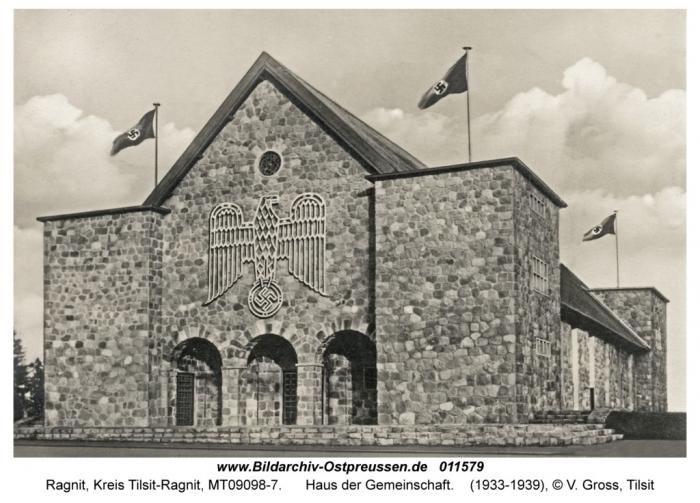

From 1933 to 1945, the church housed the Parteiburg (“Palace of the NSDAP” - National Socialist German Workers' Party). According to some sources, anti-fascist Ernst Thälmann was tortured in its basement; he was imprisoned for some time in the East Prussian prison (from 1825 to 1945, the Ragnit Order Castle served as the East Prussian prison).

After the war, the building housed the sports complex of the Neman Central Boiler Plant (CBZ). Hans-Georg Ushkoreit, a German composer and professor born in Ragnit, in the 1990s, when the building was still in perfect condition, asked for it to be demolished as a former wasp’s nest of fascists, promising to build a sports complex for children on the site at his own expense as a gift to the city. Included in the authorized capital of OAO “Neman CBZ,” the building was sold to LLC “Aero-Print” based on a purchase agreement dated April 3, 2001.

On October 1, 2006, a fire broke out in the building. Currently, the “Parteiburg” is owned by former Vice-Governor Ledenev. The historic church lacks a roof, and the historic building is gradually falling apart, presenting a pitiful sight.

Sources:

https://urban3p.ru/object20020

https://masterok.livejournal.com/5281499.html

Follow us on social media

More stories from Kaliningrad: Churches Preserved or Restored

Brandenburg Church (Saint Nicholas)

3 Pobedy St., Ushakovo, Kaliningrad Region, Russia, 238322

The Brandenburg Church (Brandenburger Kirche) is located 20 kilometers from Kaliningrad, in the village of Ushakovo in the Guryevsky urban district. Together with the village on the right bank of the Frisching River (now Prokhladnaya), the church is being built. The first mentions of it date back to 1428, but the time of construction is most likely the very beginning of the 14th century.

The Juditten Church – the oldest temple in Kaliningrad

Tenistaya Alley, 39A, Kaliningrad, Kaliningrad Region, Russia, 236010

Juditten Church (Kirche von Juditten) is a former Catholic parish church of the Order dedicated to the Virgin Mary, located in one of the districts of Königsberg (Juditten). It is considered the oldest building in Königsberg that has survived to the present day. The beginning of the construction of Juditten Church is dated to 1288, although historians do not have a consensus on this, and later dates also appear in documents.

Kirche Groß Legitten

1st Kaliningrad Street, 21, Turgenevo, Kaliningrad Region, Russia, 238646

The Gross Legitten Church is located in the Polessky District of the Kaliningrad Region, in the village of Turgenevo. It was built during the Teutonic Order period and is one of the oldest buildings in the region, with no equivalents in Russia. Before the arrival of the Teutonic Knights, there was a sanctuary of the ancient Prussians on this site. The knights built a wooden church on this sacred ground, and in the early 15th century, they erected a Catholic temple made of field boulders with brick inserts.

Kirche of Queen Louise's Memory

Prospekt Pobedy, 1b, Kaliningrad, Kaliningrad Oblast, Russia, 236010

The Queen Louise Memorial Church (Königin-Luise-Gedächtniskirche) is a former Lutheran church built in honor of the Queen of Prussia, the wife of Frederick William III. It is an architectural monument and one of the city's landmarks, currently serving as the Kaliningrad Regional Puppet Theater.

St. Catherine's Church in Arnau

Kaliningrad Highway, 10, Rodniki, Kaliningrad Region, Russia, 238312

The construction of the Church of St. Catherine in Arnau (Arnau, now the settlement of Rodniki in the Guryevsky urban district) presumably began in 1320. It is one of the oldest churches in the region.

Church of Saint Adalbert

Prospekt Pobedy, 41, Kaliningrad, Kaliningrad Oblast, Russia, 236010

The Church of St. Adalbert in Königsberg (now Kaliningrad) is a former Catholic chapel of St. Adalbert (St. Adalbertkirche). It was built in 1904 under the direction of architect Friedrich Heitmann. The architects of the lost annex were Johannes Laufer and Georg Schönweiler.

Church of the Holy Family

63a Bohdan Khmelnytsky Street, Kaliningrad, Kaliningrad Region, Russia, 236039

The Church of the Holy Family, now the concert hall of the Kaliningrad Regional Philharmonic, is a Catholic church of the Holy Family (Kirche "Zur heiligen Familie"). The church was laid down in 1904, designed by architect Friedrich Heitmann. Construction took three years, after which the church was consecrated in honor of the Holy Family. The picturesque church is called the "swan song" of architect Heitmann, who oversaw the development of the Amalienau colony and designed churches in East Prussia. The talented architect intended to build a warm family church where the spirit of Jesus Christ and his parents would reign. Heitmann wanted any member of Prussian society to be able to come here—to communicate with God and spend time in prayer.

Exaltation of the Holy Cross Cathedral

2 General Pavlov Street, Kaliningrad, Kaliningrad Region, Russia, 236006

The Exaltation of the Holy Cross Cathedral (formerly — Kreuzkirche) is an Orthodox church in Kaliningrad, located in the building of a former Lutheran-Evangelical church.

The Cathedral of the Virgin Mary and Saint Adalbert — a deconsecrated cathedral of Königsberg

Kanta St, 1, Kaliningrad, Kaliningrad Oblast, Russia, 236039

The Cathedral of the Virgin Mary and Saint Adalbert is a deconsecrated cathedral located in the historic district of Kaliningrad — Kneiphof (now officially named "Immanuel Kant Island"), one of the island parts of the former East Prussian city of Königsberg. As a cathedral, it was the main seat of the Catholic Bishop, so after the victory of the Reformation it was called Der Doom, and the name today remains from the original.

Abshwagen Church

27A-028, 25, Tishino, Kaliningrad Region, Russia, 238422

The church in Abshvangen was built between 1362 and 1365 from boulders and bricks, and was rebuilt at the end of the 15th and beginning of the 16th centuries. In 1711, a small organ made by Johann Joshua Mosengel was installed in the church, and in 1728, an altar crafted by the Königsberg master Isaac Riga was installed. In 1858, a wooden tower was added on the western side, and the building's walls were reinforced with buttresses.